

Democrats won decisively across the country on Tuesday. Data centers, on-site gas plants and clean energy were all on the ballot in some form. Voters elected governors and passed local measures that will change the course of the AI infrastructure boom.
But much of the early coverage has been misleading or wrong. Tuesday’s results don’t signal the end of the data center boom. They will, however, likely bring a pause in some of the largest markets and new regulations across the country—even in traditionally laissez-faire states like Texas.
This week’s elections will also impact the power projects that data centers depend on, likely bringing more clean energy in some states and fewer on-site gas plants in others.
Much attention has gone to Democrats’ flip of both the US House and Senate. But for the AI infrastructure boom, the races that mattered most this week were further down the ballot.
Using Cleanview’s project tracker, we ran the numbers to see which races had the biggest impacts. Here are our takeaways and what we’re still watching.
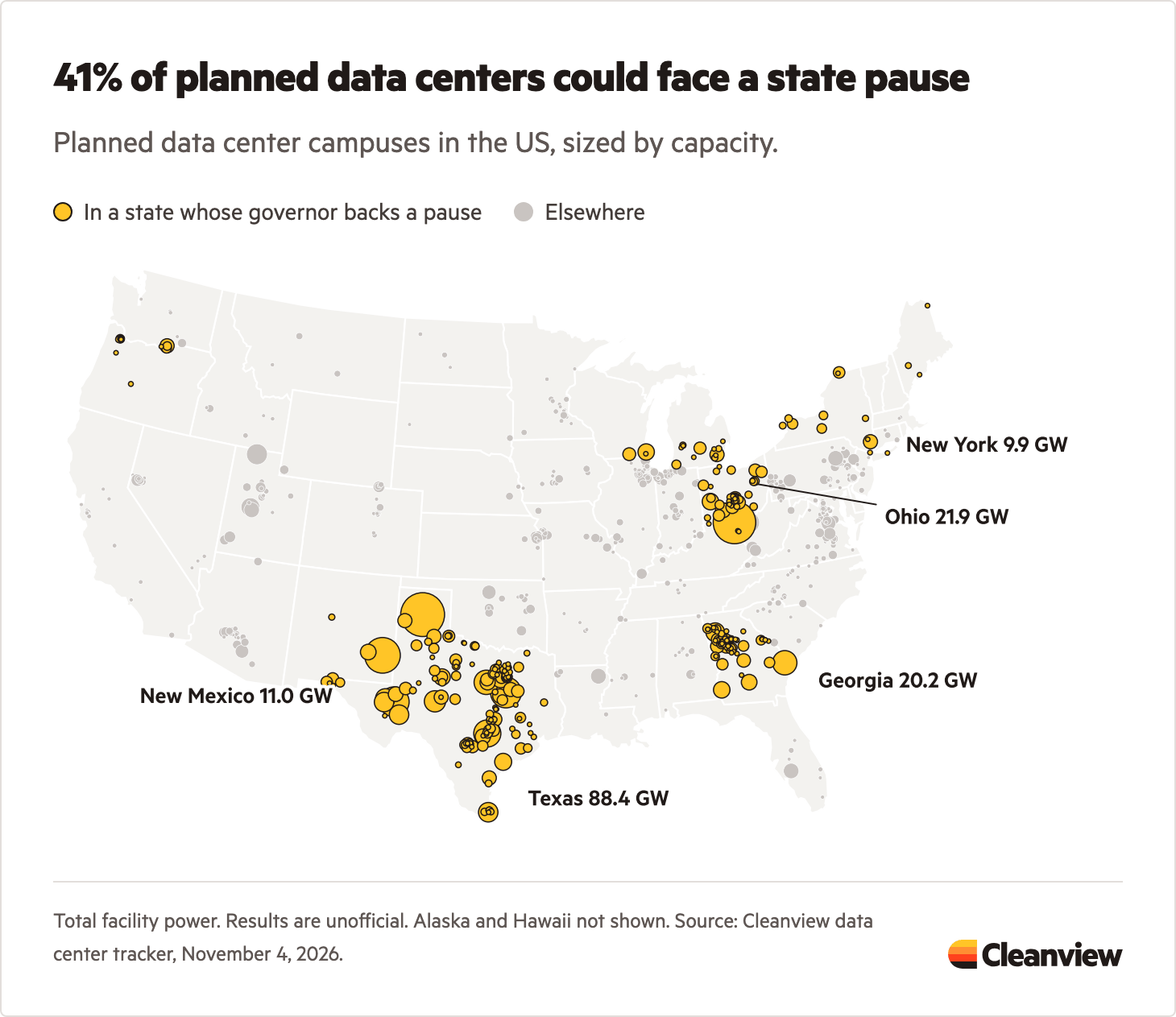
159 GW of planned data centers are in states where the governor backs a pause
As we wrote in our pre-election report, governors and state legislators have significant power to block, slow, or otherwise regulate data center development. They can pass moratoriums, strip tax breaks, appoint new utility regulators, and require more stringent environmental and labor standards.
On Tuesday, candidates who back data center pauses and more stringent rules won in many states, including states whose races weren’t considered toss-ups, like Texas.
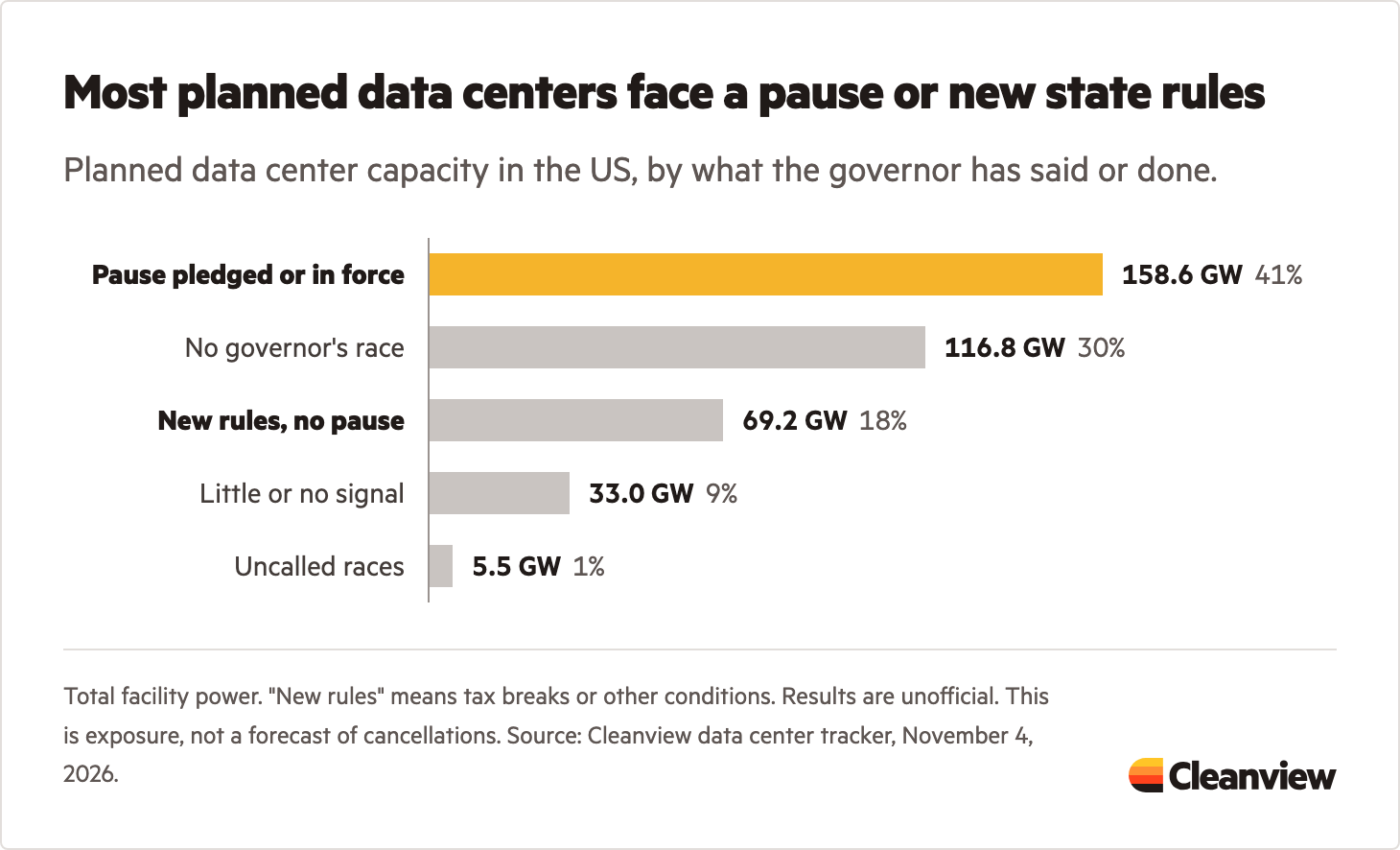
Nine states now have a governor or governor-elect who has promised or already imposed a pause on new data centers. Those states hold 158.6 GW of planned capacity, or 41% of the US pipeline.
Another 69.2 GW (18%) is in states where the winner wants to change tax breaks or other rules but hasn’t backed a pause.
Track every data center and power project in the US with Cleanview
If you enjoy reading this newsletter, you might be interested in our data subscriptions. We track thousands of data centers, renewable energy projects, and behind-the-meter gas plants. Connect with our team to learn more or download one of our sample datasets.
What Texas’ surprise means
88.4 GW of the planned pipeline is in Texas, a state whose governor’s race wasn’t considered close when we wrote about the election last month. It holds more planned capacity than the ten close races we profiled combined.
Tuesday’s results will likely extend a pause on new grid approvals and state permits that sitting Governor Greg Abbott began in August and expanded in September.
In her campaign, Gina Hinojosa promised to go further than Abbott, suggesting “a moratorium on any new data centers and any approvals for any data centers until we can pass laws to protect Texans.” Republicans still hold the state Senate 19-12, so ending it will require a deal next year when the legislature meets.
New rules are coming in Ohio and Georgia
Developers have announced 21.9 GW of data centers in Ohio that aren’t yet under construction. Amy Acton backs “a conditional moratorium” until data centers meet conditions including union labor, paying all their utility costs and bringing their own energy. She hasn’t said whether she’d do it by executive order, and Republicans kept majorities in both chambers.
Georgia will see some of the biggest changes. Keisha Lance Bottoms wants “a pause on all new construction.” Democrats also won a 3-2 majority on the Public Service Commission, which sets the terms Georgia Power offers data centers. And the state House appears to have flipped. That puts 20.2 GW of planned capacity under new management.
Governors will pause, not ban data centers
Memes circulating the internet framed Tuesday’s results as the end of the AI boom in America. But the country’s new governors promised pauses and new rules, not bans on the campaign trail.
Most candidates said a moratorium would last until the new rules are written. That means the ultimate impact of Tuesday’s results won’t be known until next year when state legislatures meet.
These pledges target new construction, which means that the 56.7 GW of data center capacity under construction nationwide is less exposed. Many of the projects that haven’t begun construction in these states will likely face delays.
On-site gas plants will likely face new rules and delays
As we’ve written, data center developers have begun building their own on-site gas power plants to get around long waits for the electric grid. Tuesday’s results will likely change the trajectory of this gas buildout.
To build an on-site gas plant, a developer needs an air permit. That approval often goes through offices controlled by the executive branch, which means new Democratic governors could delay or block those permits.
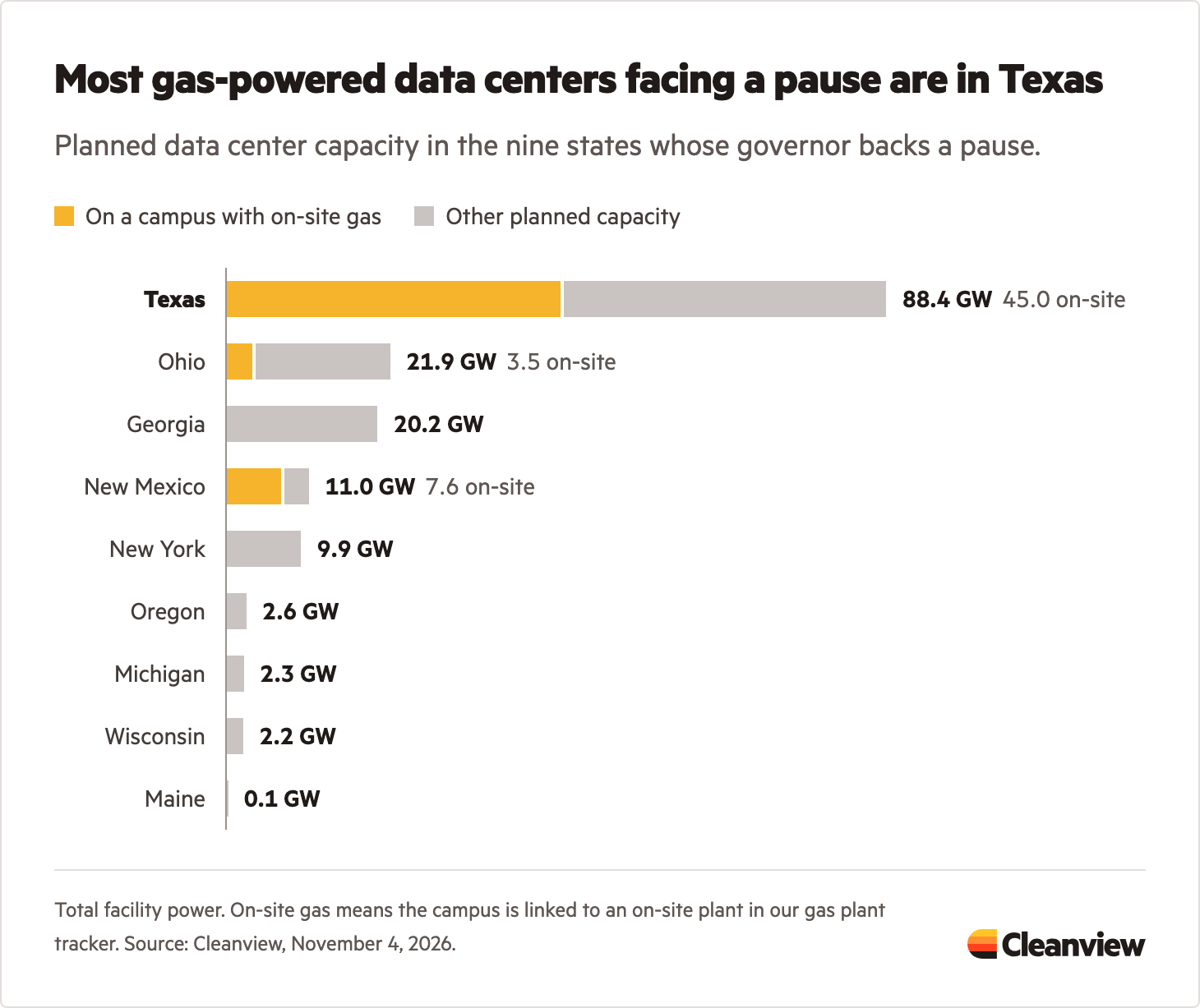
Of the planned capacity in states with pauses coming, 56.1 GW include on-site gas, and 45 GW of that is in Texas, where Gina Hinojosa could extend Greg Abbott’s permit pause.
In New Mexico, the air permit for OpenAI’s Project Jupiter gas plants is still pending. Gov.-elect Deb Haaland pledged a day-one executive order, but only “until the state has adopted robust protections.”
Developers may need to buy more clean energy
A number of candidates campaigned on a promise to make data centers buy more clean energy.
David Crowley in Wisconsin called for 100% renewable energy as a condition for communities that accept a project. Haaland’s plan calls for self-built renewables. Michigan Democrats have proposed a bill requiring 90% clean procurement.
The exact specifics of these clean energy requirements will be hashed out next year. New rules will decide whether developers have to match their load annually or hourly, and whether the power has to be on the same grid. Annual matching would favor the cheapest solar and wind, whereas hourly matching would favor storage and firm power.
But clean energy rules won’t reach everywhere. States with a clean power rule in force or proposed hold 88 GW, about 23% of the current data center pipeline. We didn’t find any clean energy proposals from the winning gubernatorial candidates in Texas, Ohio or Georgia.
Track every data center and power project in the US with Cleanview
If you enjoy reading this newsletter, you might be interested in our data subscriptions. We track thousands of data centers, renewable energy projects, and behind-the-meter gas plants. Connect with our team to learn more or download one of our sample datasets.
Local elections went overwhelmingly against data centers
Data centers were directly on the ballot in 41 local elections across the country, according to Ballotpedia. Some ballot initiatives proposed outright bans, while others proposed temporary pauses. By our tally of unofficial returns, the side limiting data centers won at least 36 of them.
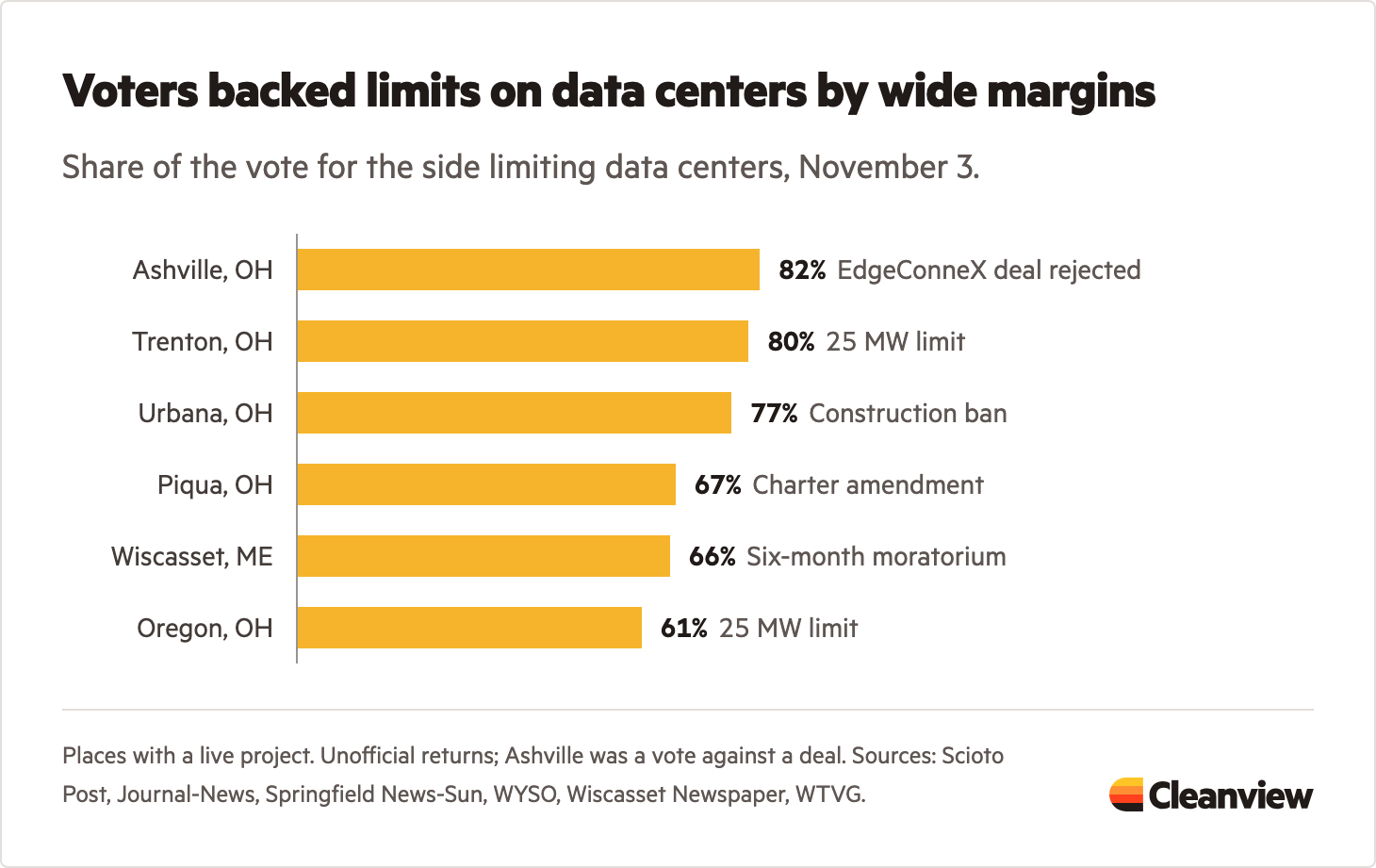
In Piqua, Ohio, about 67% of voters backed a charter amendment aimed at Meta’s 1.4 GW campus, and they recalled the mayor and two other commissioners. In Oregon, Ohio—not to be confused with Oregon, Oregon—voters capped data centers at 25 MW after Vantage said it would “seriously consider not being here” if the community didn’t want it.
The megawatts directly affected look small, at least 1.6 to 1.9 GW among projects with a reported size. The bigger effect could be on how officials across the country read the results and risks of future votes.
Most major AI companies will be impacted
Most hyperscalers and AI labs have planned projects in states where the governor backs a pause.
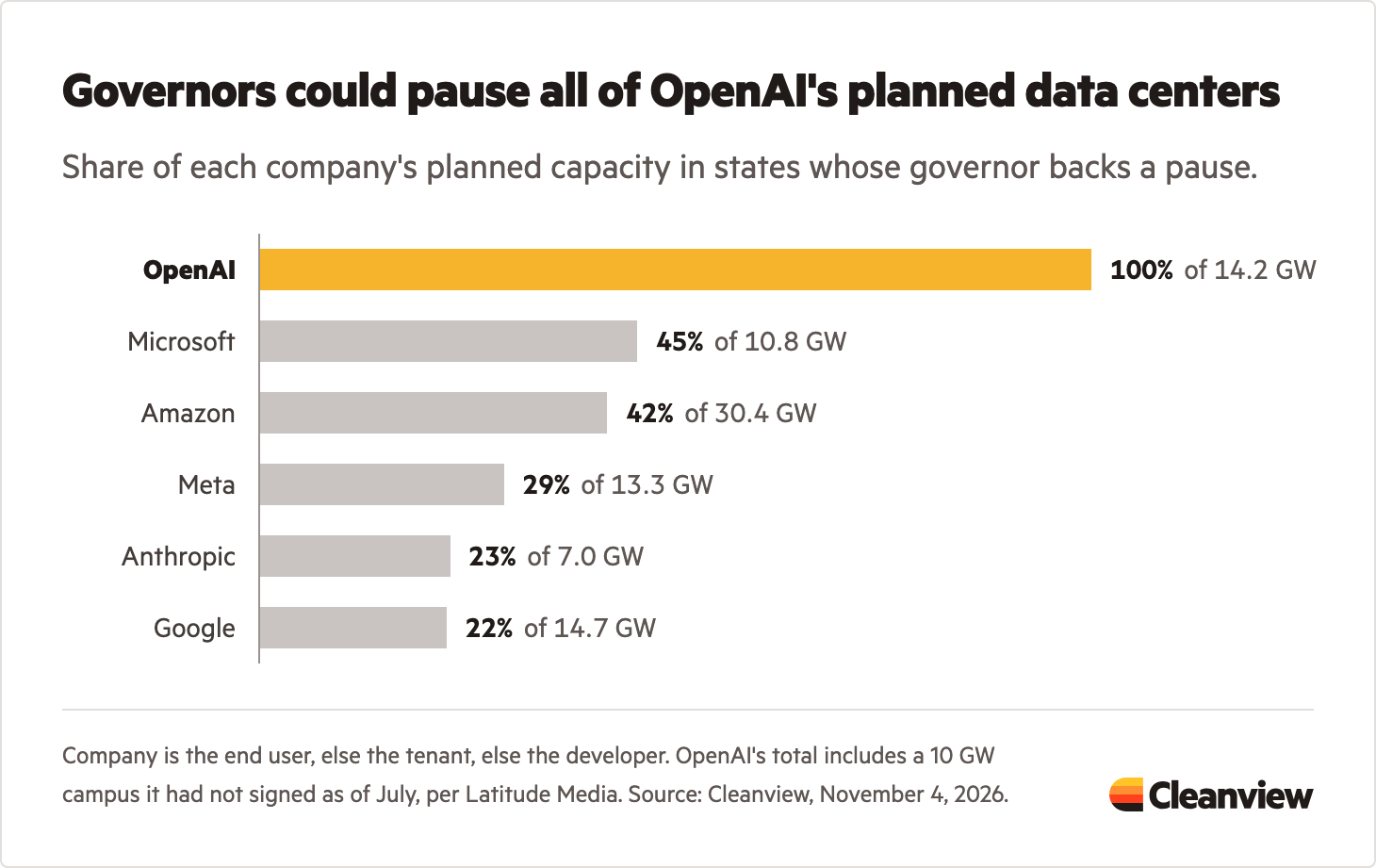
OpenAI’s entire planned pipeline is located in states with a new governor who backed a pause on the campaign trail. The company’s Project Jupiter will likely face more challenges. Most of the New Mexico campus is under construction, but the air permit for its gas plant is pending. Haaland wrote that as governor, the project would “not exist” and any new permitting would be “held to the highest standards on community benefits, water, pollution, energy and labor practices.”
In Georgia, Effingham County tabled the site plan for OpenAI’s 3.2 GW Project Camellia on election night until November 17.
Questions we’re still asking
Will local officials be afraid to approve data centers? Voters recalled the mayors of Piqua and Urbana. How many local officials will see those results and change their voting behavior as a result?
Will siting boards block on-site gas? Voters in Ashville, Ohio, rejected a deal with EdgeConneX by about 82%. But its 800 MW gas plant is up to the Ohio Power Siting Board (OPSB), not the village. Local organizers said they hoped Tuesday’s vote would signal to the OPSB that the community doesn’t want the gas plant approved.
What will the new guardrails look like? Most pauses name conditions and new guardrails. But campaign proposals and statements lacked many specific details. In some cases, governors will have to negotiate the new rules with Republican legislators. Those details and debates will decide whether these pauses last months or years, and what data center development looks like afterwards.
How will developers respond? Moratorium candidates lost in Oklahoma, Florida and Alabama. Will developers flock to these states or to Republican-led states that didn’t have gubernatorial elections this year, like Utah and West Virginia?
Will developers build in other countries or space? By coincidence, Google announced a planned $15 billion investment in Malaysia yesterday. Elon Musk, whose company SpaceX is developing data centers in space, wrote on X last night, “Data centers in space looking pretty appealing right now.”
Track every data center and power project in the US with Cleanview
If you enjoy reading this newsletter, you might be interested in our data subscriptions. We track thousands of data centers, renewable energy projects, and behind-the-meter gas plants. Connect with our team to learn more or download one of our sample datasets.


