

Today we’re publishing The Geography of Compute, our report on where companies are building data centers in the US and why. Today’s story comes from the report’s final section, on the 2026 midterms. If you’re interested in the full report, reach out to learn more about Cleanview’s research subscription. If you’re a journalist, contact us here.
Data centers have become one of the biggest issues of the 2026 midterms. Since January, campaigns and outside groups have spent more than $45 million on ads that mention data centers, according to an NPR analysis of AdImpact data.
In Ohio, Democrat Sherrod Brown is running ads that call Republican Sen. Jon Husted “the face of data centers in Ohio.” In Michigan, Republican Senate candidate Mike Rogers backs a one-year moratorium on new data centers. In Texas, both Senate candidates want to end the state’s sales tax break for data centers.
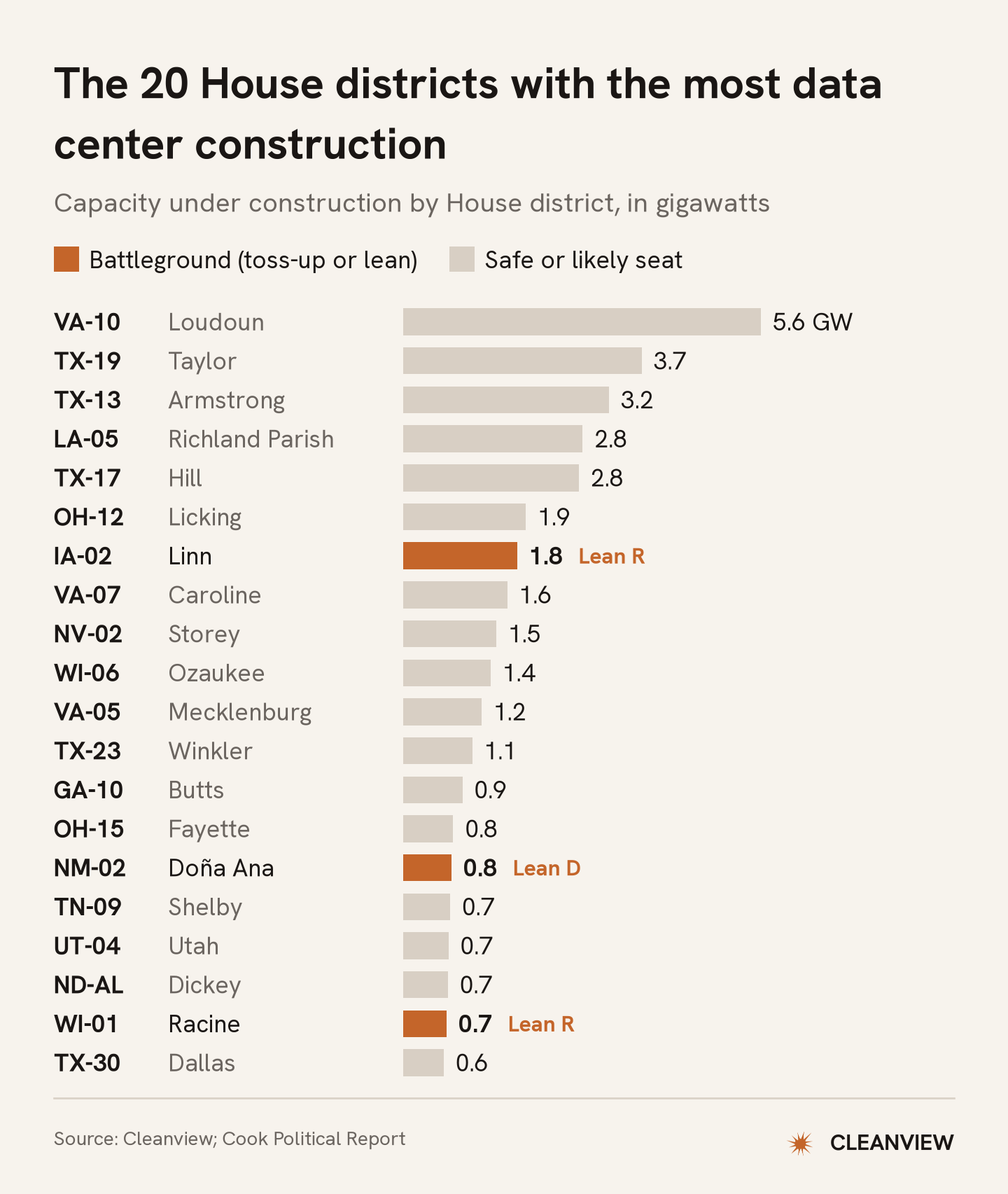
But the near-term future of data centers in America won’t be determined by Congressional midterm elections. Instead, the fate of America’s AI buildout depends on races further down the ballot.
President Trump has made his support for data centers clear. Last month he wrote that towns fighting data centers are choosing to be “backwards and poor.” When Texas’ Governor, Greg Abbott, paused data center approvals in August, Trump called the decision “a mistake.” The President’s support and veto power would make it difficult for Congress to pass any meaningful legislation that regulates data center development.
At the state level, the picture is very different. Governors and state legislators have significant power to block, slow, or otherwise regulate data center development. They can pass moratoriums, strip tax breaks, appoint new utility regulators, and require more stringent environmental and labor standards.
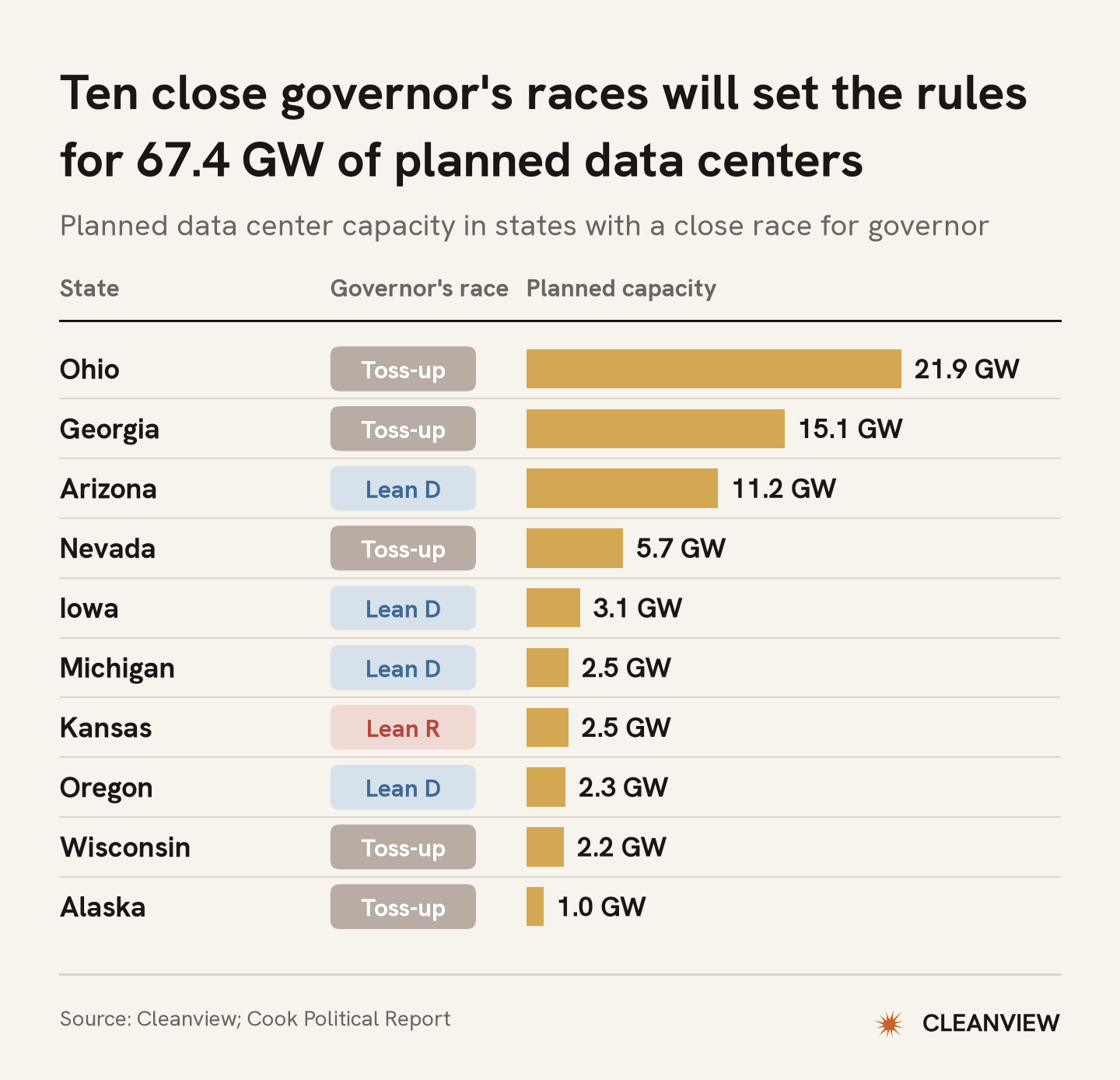
In our latest report, we found that ten close governor’s races will set the rules for 67.4 GW of planned data centers. That’s more than the 62.7 GW of data centers operating in the entire US today. We estimate that this represents more than $2 trillion of potential AI infrastructure investment.
None of these projects have started construction yet, which means the next governor could still decide whether, and on what terms, they get built.
In Ohio, both candidates have suggested a pause
No state with a close governor’s race has more planned data center capacity than Ohio. Developers have announced 21.9 GW of data centers there that haven’t yet broken ground. The Columbus area is already one of the fastest-growing data center markets in the country.
Both candidates for governor say they’d slow that growth down. Republican Vivek Ramaswamy says that on his first day in office, he would “immediately halt the approval of any new data center projects” until his data center law passes. Under his plan, data centers would have to give nearby residents free electricity or compensation and pay full property taxes. Democrat Amy Acton backs a moratorium until data centers pay 100% of their utility costs, among other conditions.
The current governor, Mike DeWine, has already paused new data center tax exemptions.
In Georgia, candidates back very different policies
No race in the country has seen more spending on ads that mention data centers than Georgia’s race for governor where candidates have spent $12.8 million, according to NPR. Developers have announced 15.1 GW of data centers in Georgia that haven’t started construction.
Democrat Keisha Lance Bottoms wants a temporary statewide pause on new data center construction. “Let us take a pause, assess fully, assess comprehensively, assess the impact that these data centers are having on our environment, on our utility bills,” she said, according to the Georgia Recorder.
Republican Rick Jackson wants to leave the decision to local officials. “Every community should decide,” he has said.
OpenAI has the most at risk
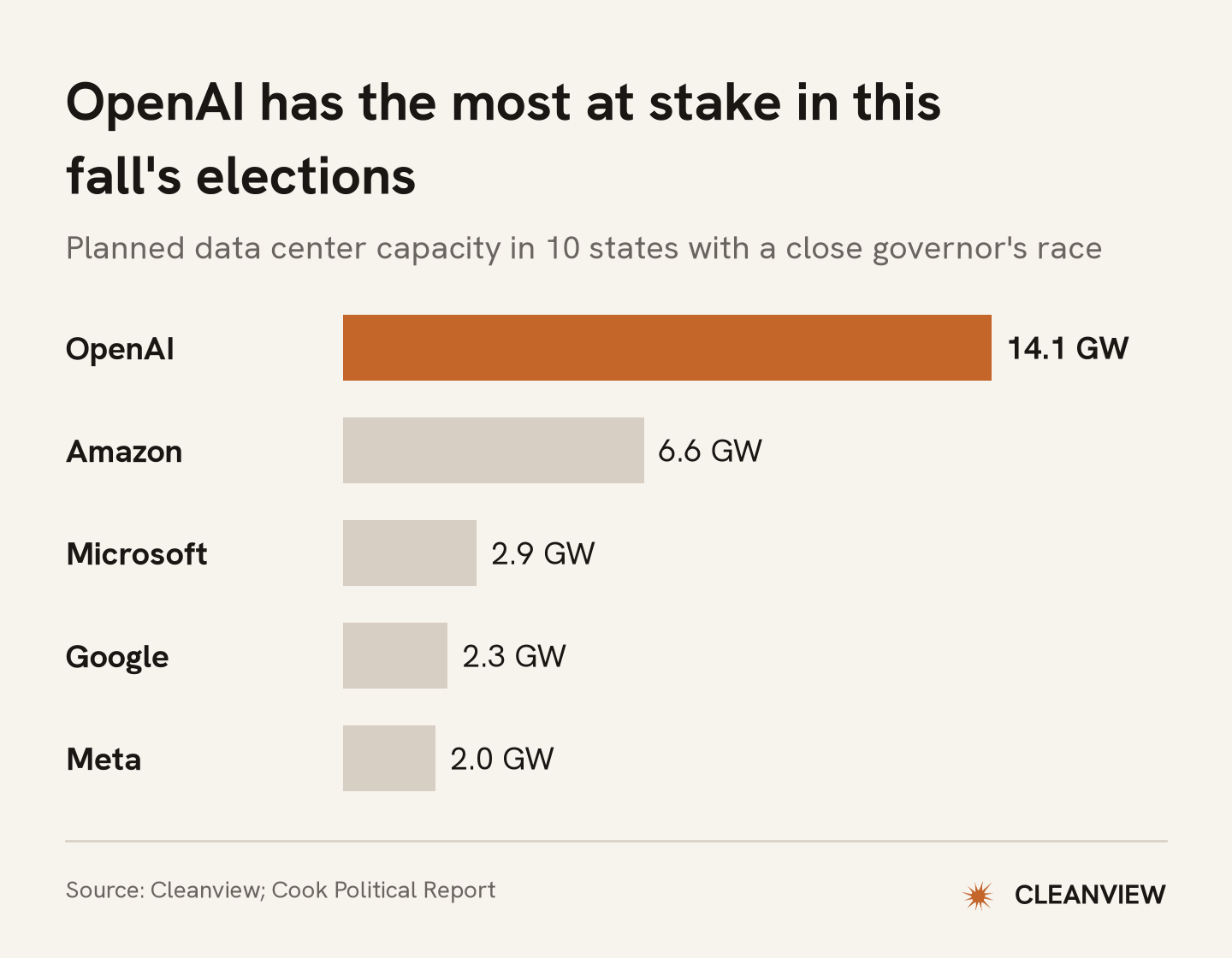
OpenAI has more data center capacity at risk this fall than any other company. Most of the data centers OpenAI is building today are in Texas, which doesn’t have a close governor’s race. But its next wave is in the states that do. OpenAI has 14.1 GW planned in states with a close governor’s race, 84% of everything it has planned.
In Pike County, Ohio, SB Energy is building a 10 GW campus for OpenAI, one of the three largest data center projects we track. It sits partly on land owned by the Department of Energy, and the US government will own the 9.2 GW of gas generation built to power it. That could limit what a new governor can do.
But the campus still depends on state approvals. SB Energy is paying $4.2 billion for new high-voltage lines through AEP Ohio, a utility overseen by regulators the governor appoints. The first 800 MW is expected online in 2028.
In Effingham County, Georgia, about 45 minutes outside Savannah, OpenAI is developing Project Camellia, a $20 billion, 3.2 GW campus. That project isn’t yet under construction. If Democrat Keisha Lance Bottoms wins and follows through on her pause, the project could see significant delays. The Cook Political Report rates the election a toss up.
Over the last few months, there has been a lot of talk about slowing down AI development and “pacing the frontier.” Many proposals laid out by labs and policymakers have focused on the speed at which models are released. Next month, voters may force a different kind of slowdown and pace the speed at which compute is built.
Get the full report
The midterms are one part of The Geography of Compute. Here’s what’s inside the full report:
Where data center construction is moving: the established markets that are still growing, and the nine new markets with more than 1 GW under construction each
Who is building: hyperscalers, AI labs and neocloud developers, and the states they’re expanding into
Why developers are going to remote places and siting projects near gas pipelines instead of the high-voltage grid
The Senate and governor’s races, House districts and candidates’ proposals that could shape the next wave of projects
Data center capacity by state, county, utility and balancing authority, and the 50 largest campuses in the US
If you’re interested in receiving the full report, reach out to learn more about Cleanview’s research subscription. If you’re a journalist, contact us here to get a copy.
A great reminder that down-ballot races in a midterm election really matter! Thank you!