

Mega-scale data centers tend to make their presence known, both in their local communities and, often, the world at large. Meta’s Hyperion will cover 3,200 acres of Louisiana farmland, almost four times the size of Central Park, and 10 gas plants are planned to power it. Its sister data center in New Albany, Ohio, Prometheus, takes its name from mythology and features more advanced chips than nearly any other compute cluster in the world. xAI’s Colossus, OpenAI’s Stargate and Project Rainier, which Amazon built for Anthropic, are similarly large and grandly named.
But some of the largest data centers in the world have gone largely unnoticed. QTS Richmond is one of them.
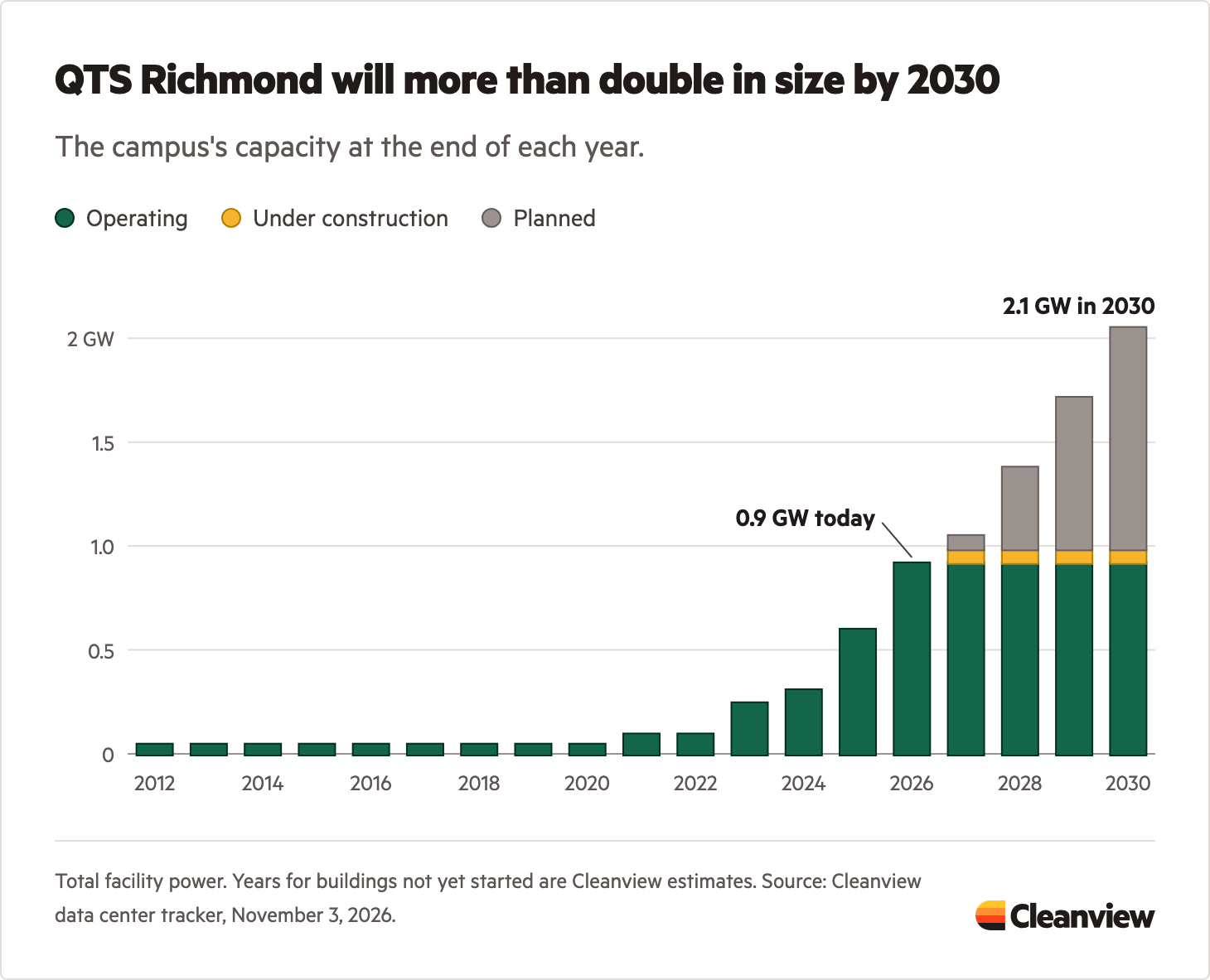
The campus, in Henrico County, Virginia, ranks third in Cleanview’s rankings of the largest operating data centers, with 921 MW of capacity spanning 16 buildings. Only xAI’s Colossus 2 and Amazon’s New Carlisle campus, the home of Project Rainier, are larger. By 2030, QTS Richmond will be more than twice its current size.
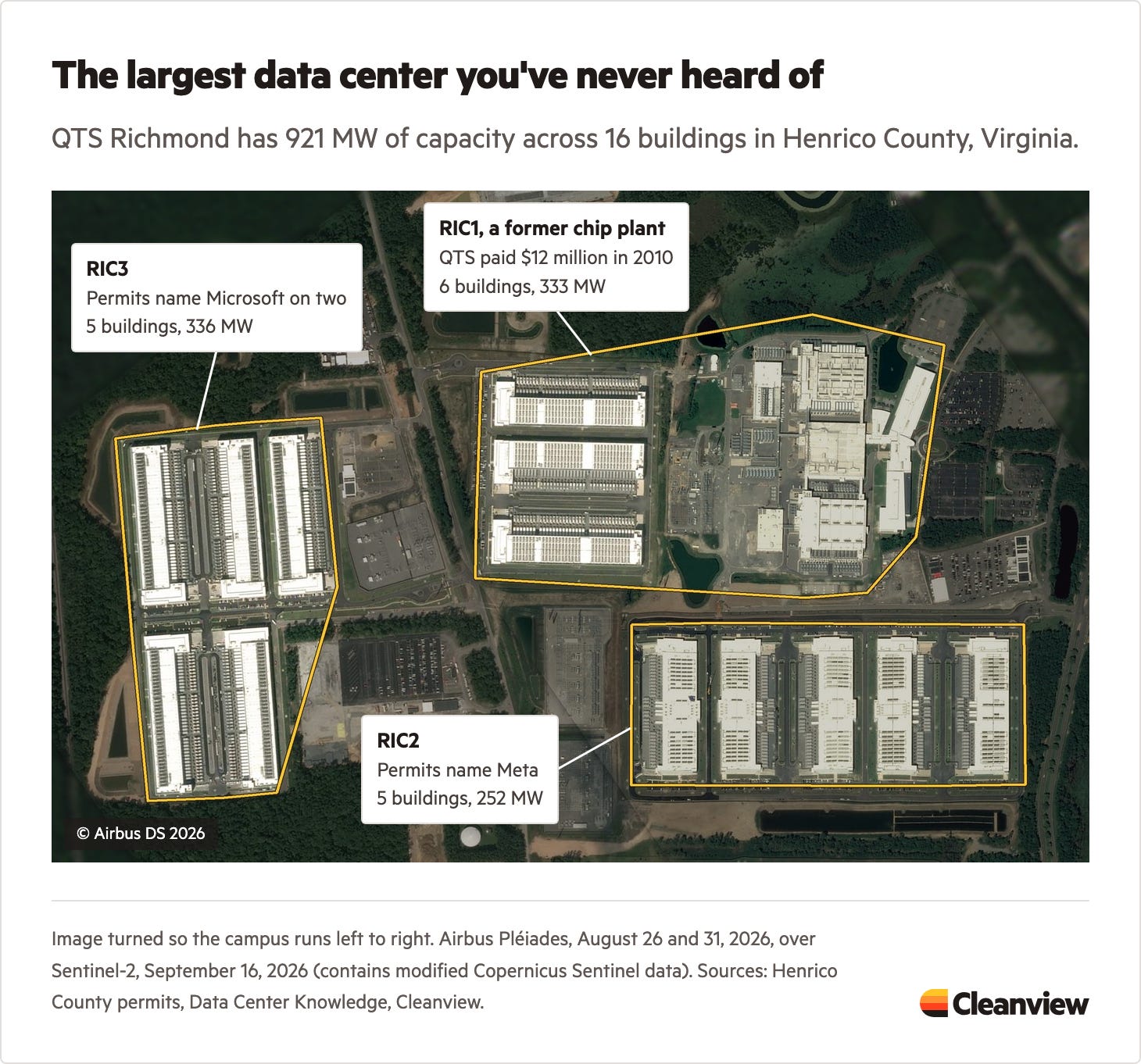
The QTS Richmond campus started as a bankruptcy sale. In 2010, QTS paid $12 million for a shuttered Qimonda memory chip plant on 210 acres. For most of the next decade, it filled the old plant slowly.
Then the AI boom arrived. About two-thirds of the campus’s capacity has come online since the start of 2025. The most recent building passed its final inspection two weeks ago.
QTS doesn’t say who is inside. But Henrico County’s permits do. We read 774 permits on the roads around the campus, and they name two main tenants: Meta and Microsoft.
Track every data center and power project in the US with Cleanview
If you enjoy reading this newsletter, you might be interested in our data subscriptions. We track thousands of data centers, renewable energy projects, and behind-the-meter gas plants. Connect with our team to learn more or download one of our sample datasets.
Meta’s name is on five of the buildings, with about 250 MW between them. That’s nearly as much as the 261 MW at the campus Meta owns next door. Microsoft’s name is on four more buildings.
The next phase is already underway. QTS has lined up another 1,100 acres nearby, with plans for as many as 17 more buildings. Steel for the first one was going up in August. Dominion Energy has approval to build new transmission lines into the area, sized for 600 MW of new load by 2028.
The landlord to the hyperscalers
The project’s developer, QTS, is unknown to most people outside the data center industry.
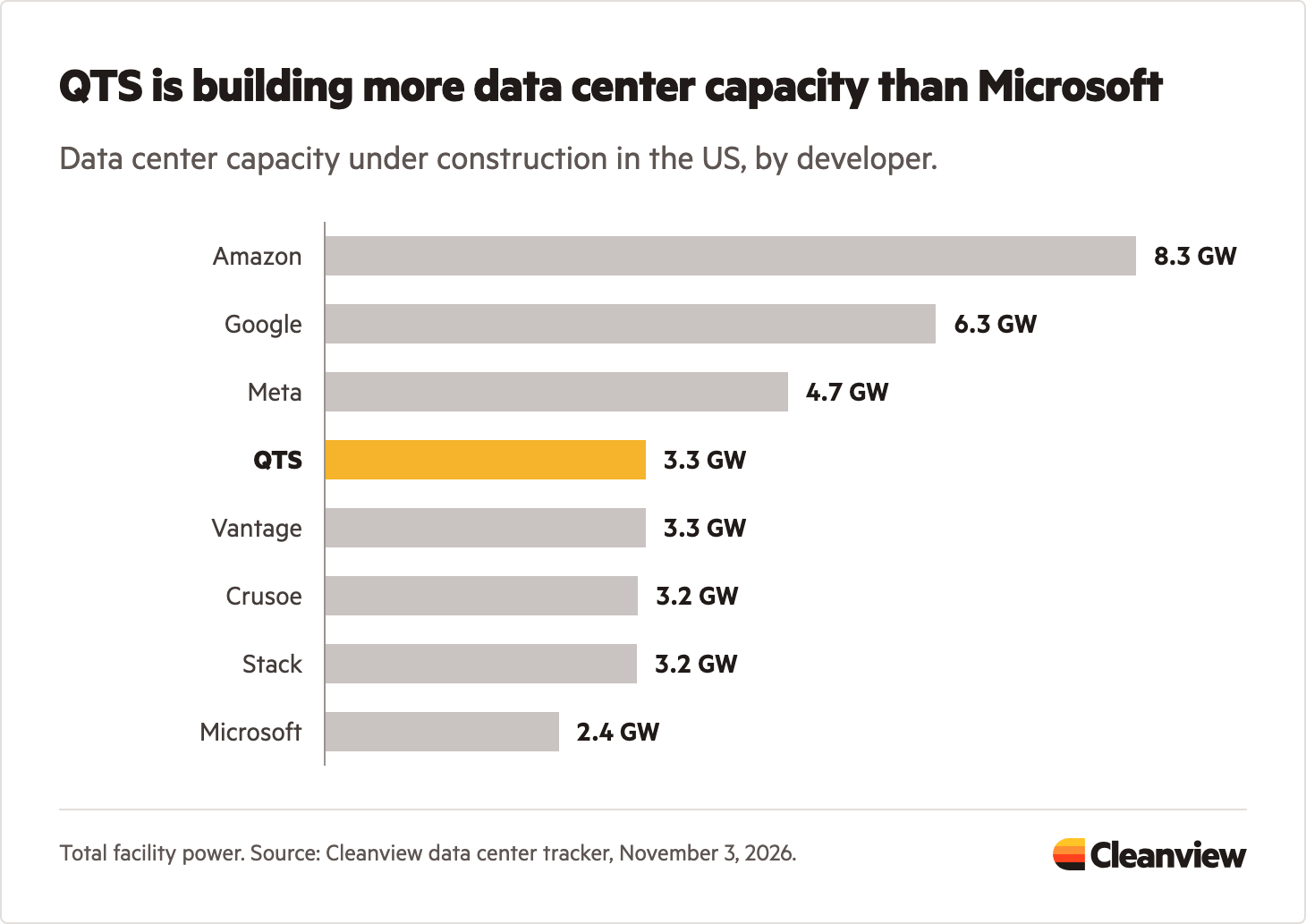
But while QTS doesn’t have the same name recognition as Amazon, Google, Meta and Microsoft, it is building almost as much data center capacity. QTS has 3.3 GW under construction, according to Cleanview data, more than Microsoft and behind only Amazon, Google and Meta. It also owns the next campus on our operating list: an 859 MW site in Fayetteville, Georgia, leased to Microsoft.
Blackstone bet on the data center boom long before many others. The firm took QTS private for about $10 billion in 2021, “well before ChatGPT arrived,” as CEO Steve Schwarzman put it this year. QTS had about 400 MW of capacity at the time. By the summer of 2025, it had 3 GW, Bloomberg reported.
The company has grown rapidly since then. “We are gonna do 6 gigawatts this year,” Blackstone president Jon Gray said on the firm’s October earnings call, referring to new data center leases across its global platform. That’s three times last year’s total.
Working with QTS enables hyperscalers to rent capacity without forking over billions in capital expenditures. A hyperscaler that builds its own data center pays most of the money upfront. Leasing from companies like QTS enables them to spread those payments over many years—albeit at a premium.
Gray recently said Blackstone’s leases typically run 15 to 20 years. Moody’s counted $662 billion in leases that the five biggest hyperscalers had signed but not yet started at the end of last year. None of it was on their balance sheets.
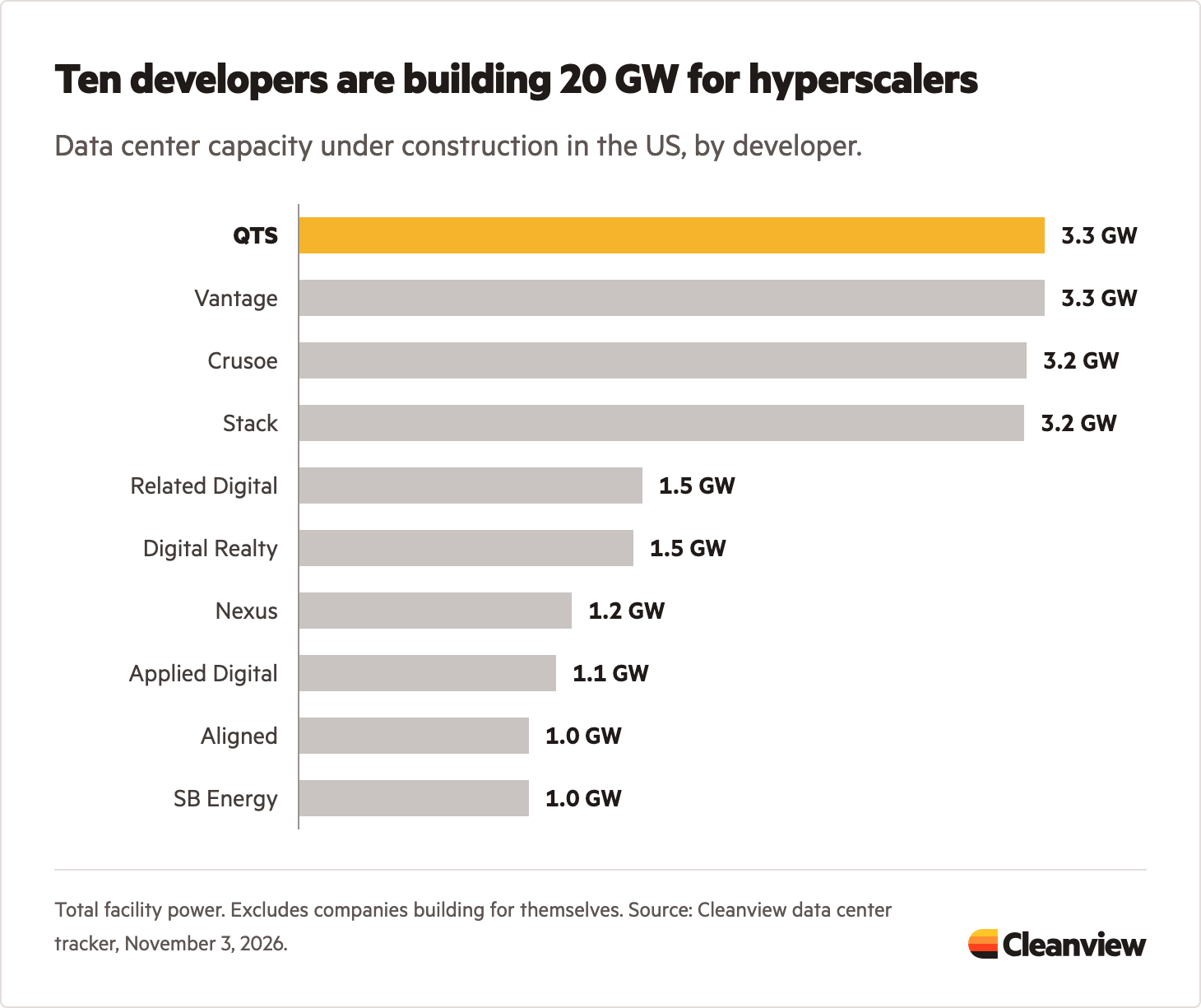
QTS isn’t the only relatively unknown company building for hyperscalers.
Amazon, Google, Meta and Microsoft are building 22 GW of the data center capacity under construction in the US. Other companies are building 35 GW, more than 60% of the total.
Since the AI boom began, these companies have had to compete with hyperscalers for limited physical materials like transformers, backup generators, and turbines. Now they are running into a new bottleneck: a limited supply of cash.
Last week, the Wall Street Journal reported that many data center developers have effectively been shut out of the debt market. CoreWeave, Nebius and Nscale have all struggled to borrow recently, according to The Journal.
Elon Musk predicted many of these companies will fail. “That means the 200+ neoclouds are going to see guppy-level death and consolidation,” he wrote on X. “Some will make it through, but not many.” It’s worth noting that Musk is a competitor: SpaceX, which merged with xAI this year, sells computing capacity too. Nvidia CEO Jensen Huang said neocloud demand is “off the charts.” (His company, too, is conflicted with billions invested into neoclouds).
Over the last decade, QTS turned a $12 million chip plant into one of the largest data centers in the country. The next few years will test how many other developers can raise the money to do the same.
Track every data center and power project in the US with Cleanview
If you enjoy reading this newsletter, you might be interested in our data subscriptions. We track thousands of data centers, renewable energy projects, and behind-the-meter gas plants. Connect with our team to learn more or download one of our sample datasets.


The Nebius detail says a lot about how tight that debt window has become. This is a company that only exists because Yandex split — the Russian business was sold for $5.4B and the leftovers re-formed as Nebius — and it still landed a $17.4B Microsoft deal within about a year. If a borrower carrying a contract like that struggles to raise debt, the 200-plus smaller neoclouds are borrowing against hope, not paper.