

Electricity demand is growing faster than it has in decades in the United States. Data centers, manufacturing reshoring, and electrification are driving massive growth in power consumption. But at the moment America needs more electricity generation, the country’s infrastructure developers are cancelling projects at an alarming rate.
Over the last few weeks, we’ve been analyzing data to see how many power projects have been cancelled this year. In our latest report, we found that 1,891 power projects with a combined 266 GW of generation capacity have been cancelled in 2025—equivalent to roughly one-quarter of America’s entire current electricity generation capacity.
Clean energy projects have been hit hardest, accounting for 93% of project cancellations in 2025. Utility-scale solar alone saw 86 GW cancelled, while battery storage projects lost 79 GW and wind projects shed 54 GW.
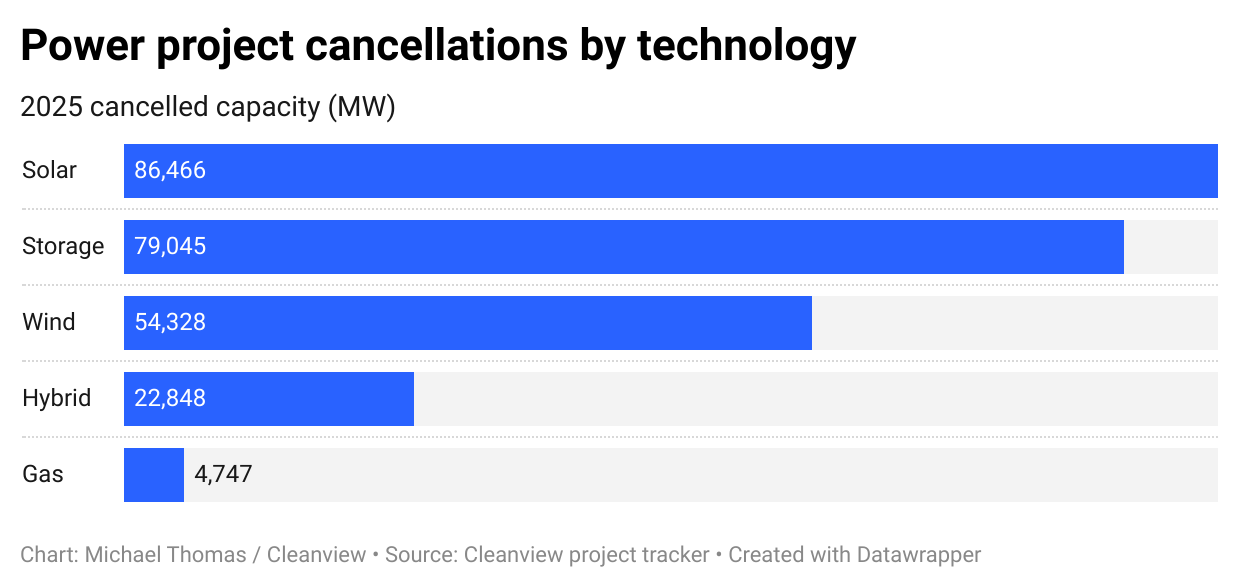
The Trump administration and their chaotic policies were responsible for many of these project cancellations. But the analysis showed that there’s much more causing project cancellations and preventing the buildout of clean energy than federal policy.
While each region and grid faces unique challenges, five patterns emerged across the 1,891 cancelled projects that we analyzed:
Local opposition is killing projects where electricity demand is growing fastest
Virginia—home to the country’s largest data center market—lost 6.7 GW of potential capacity. In Ohio, where elected officials have courted hyperscale data centers, the state has blocked more clean energy projects than any other. In Indiana, another data center hotbed, 44% of proposed data centers are located in counties that restrict renewable energy development.
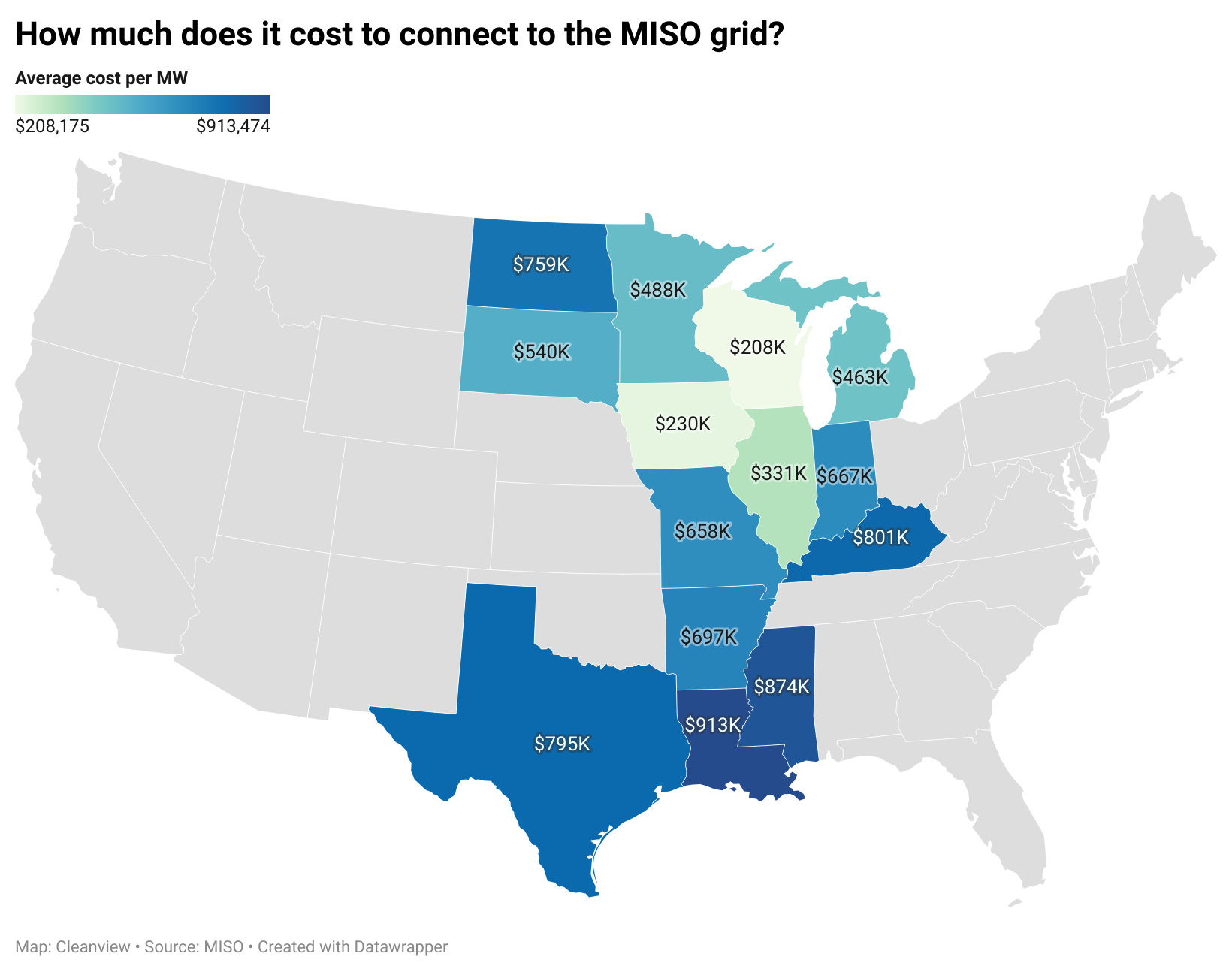
A failure to build transmission lines is resulting in high interconnection costs
High-voltage transmission construction has plummeted from 4,000 miles in 2013 to just 322 miles in 2024—less than one-tenth of the 5,000 miles per year needed. In MISO, average interconnection costs for cancelled projects hit $753,116 per MW—roughly half of a typical project’s total capital cost. Louisiana and Missouri, with costs exceeding $900k per MW, lost 26 GW of capacity combined in 2025.
Battery storage economics are worsening from market saturation and tariffs
“Battery cannibalization”—where growing capacity drives down the prices batteries earn—is making it harder to build profitable battery projects. Texas battery revenues crashed 70% from $192/kW in 2023 to $55/kW in 2024, while ancillary service prices fell 90%. California saw similar declines, with revenues falling from $103/kW in 2022 to just $53/kW in 2024. Meanwhile, Trump’s tariffs have increased the cost of batteries by 56-69%.
Trump’s War on Wind killed gigawatts of potential capacity
Since taking office, the Trump administration has systematically dismantled offshore wind development through sweeping policy actions, funding cancellations, and construction halts. These moves led to massive waves of project cancellations in New York (13 GW), New England (11 GW), and California (2.5 GW).
Grid operators cleaned up their interconnection queues
Starting in 2023, ISOs implemented sweeping reforms to eliminate speculative projects from their queues. New cluster processes, higher deposits, and compressed timelines resulted in hundreds of project cancellations. In MISO, 62% of 2025’s 73.4 GW in cancellations came from a single study cycle. SPP saw 27 GW cancelled in August 2025 alone following interconnection study results. While reforms improved queue quality, they accelerated project cancellations.
Cancelled projects will result in higher power prices and less economic growth
These project cancellations will affect nearly every American. The 266 GW of lost capacity threatens higher electricity prices for households and businesses as supply fails to keep pace with surging demand—a dynamic already visible in PJM’s double-digit annual price increases.
Beyond higher bills, the cancellations represent a massive economic loss. We estimate that the 1,891 projects cancelled this year would have generated $400 billion in investment—capital that would have flowed disproportionately to rural communities in need of economic revitalization.
The current trajectory is unsustainable: America is simultaneously approving unprecedented electricity demand while cancelling the generation needed to meet it, creating policy incoherence that threatens grid reliability, affordability, and the country’s competitiveness in the global AI race.
You can read the full report by clicking the button below:


I just want to compliment the writers and editors of this resource. This is some of the clearest, best reporting on the discussion of energy development I've read.
It's embarrassing to read how we are shooting ourselves on the foot by our own leaders. We would have been much better of if our leaders took no action, just let the market continue on its own following less cost options to integrate cheapest generation rather than cancelling all these GWs