

Last winter, Puget Sound Energy, one of the largest utilities in the Pacific Northwest, tried to purchase one of America’s largest solar and storage projects out of bankruptcy. Facing a power squeeze, the utility saw something rare in the Sunstone Solar and Storage project: 1.2 gigawatts of shovel-ready solar generation and 7.2 GWh of battery capacity—enough to power millions of homes.
But after 16 rounds of bidding, Puget Sound learned that it had been outbid—not by another utility, but by one of the largest tech companies in the world: Amazon.
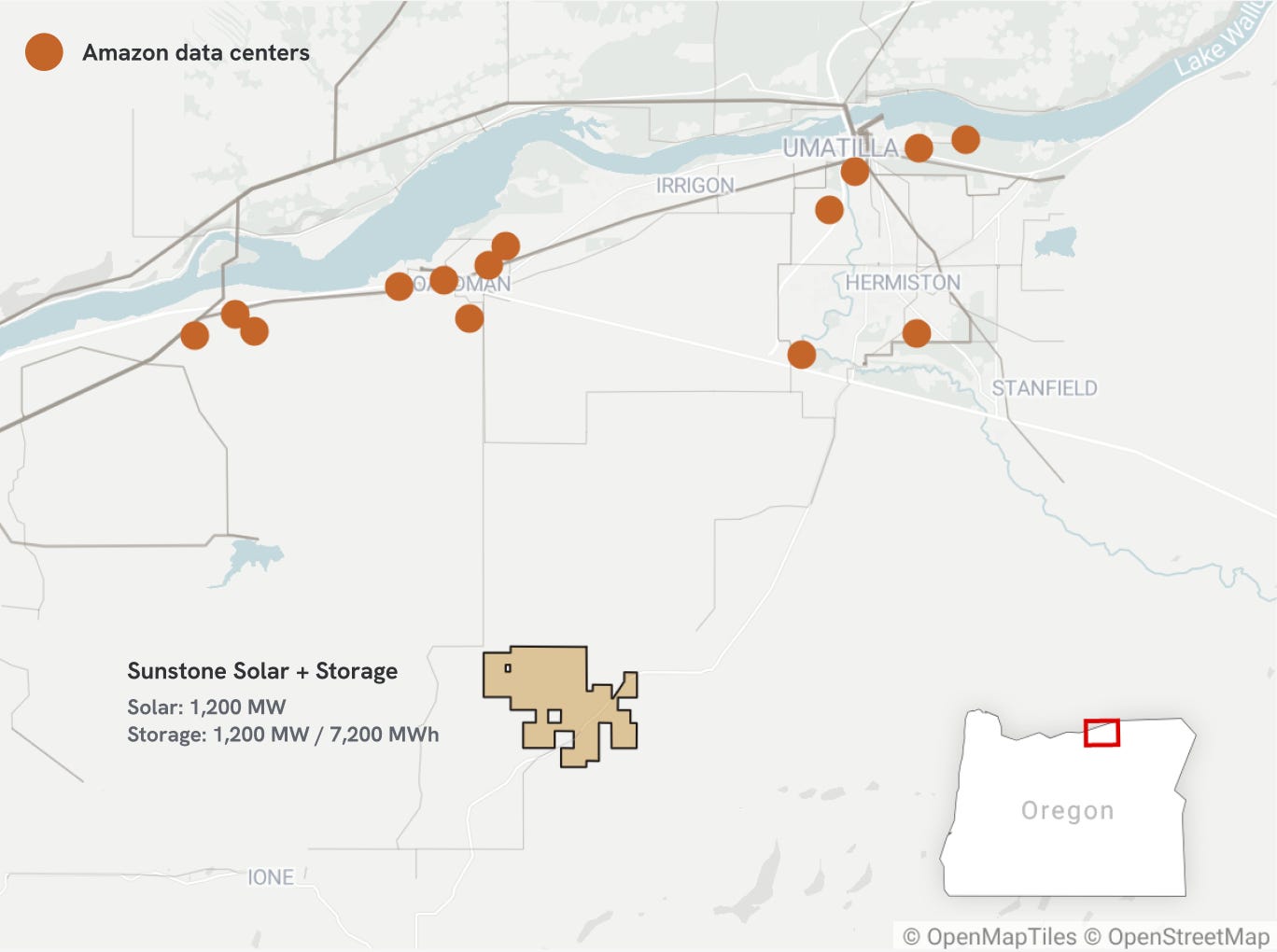
Like other tech companies, Amazon has spent billions of dollars over the last decade paying clean energy developers for carbon-free electricity. But its purchase of Sunstone and its acquisition of the massive GW Ranch natural gas plant we reported on earlier this month are different.
In Oregon, like Texas, Amazon is beginning to look more like a traditional electric utility than a buyer of electricity. Sunstone is the first generation project the company will own, build, and operate itself. Including construction, Amazon will spend roughly $3 billion on it.
So why would a tech company become a solar developer?
Over the last few weeks, Cleanview’s team reviewed hundreds of permits, corporate filings, and other public records to find an answer to that question.
A power squeeze in the Northwest
In 2010, Amazon began building its second major compute region to power its fast-growing AWS cloud business. Like Google and Microsoft, the company was drawn by the region’s plentiful, carbon-free electricity. Some of the largest hydroelectric dams in the world offered some of the country’s lowest industrial electricity prices.
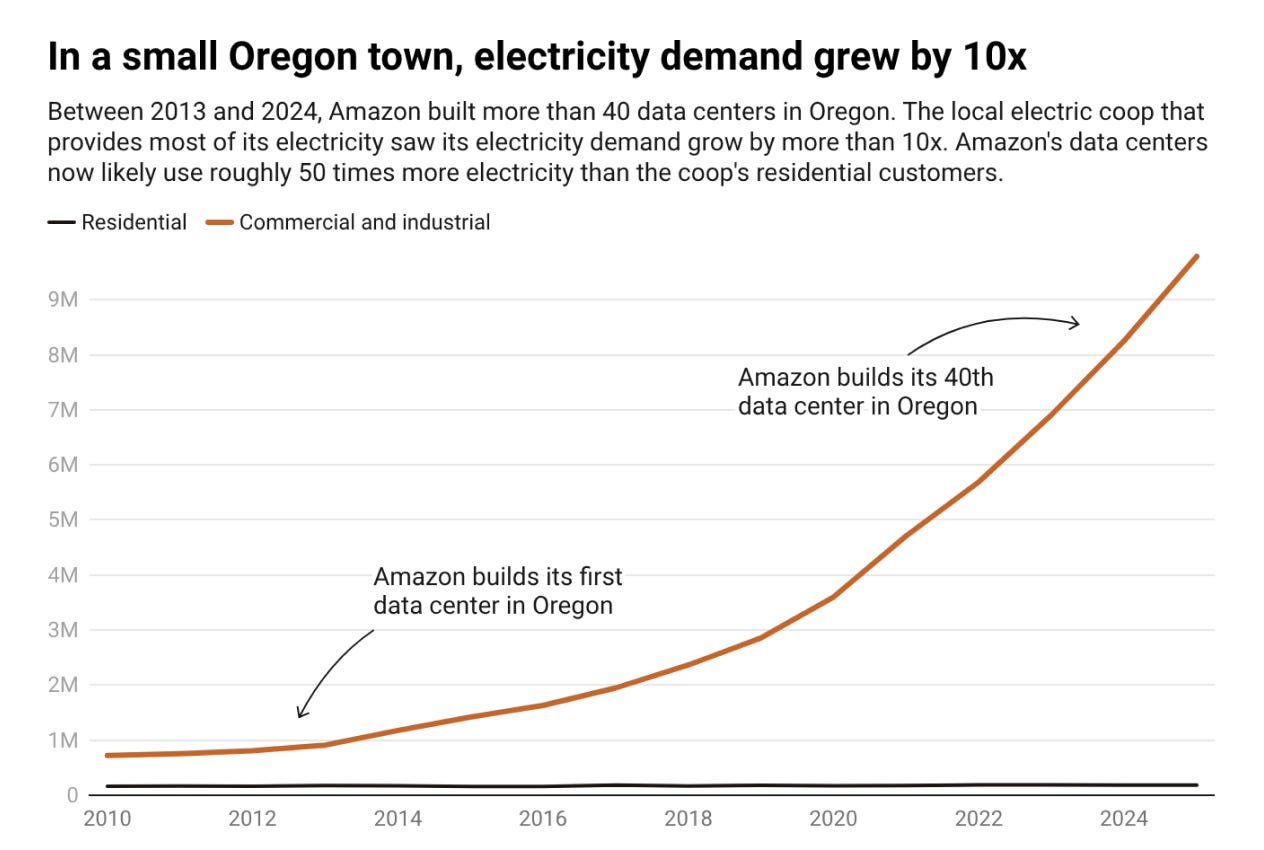
Over the next decade, the company went on a data center building spree in the region. Between 2013 and 2024, the company built 40 data centers in Eastern Oregon with a combined power capacity of 3.3 GW, becoming by far the region’s largest consumer of electricity.
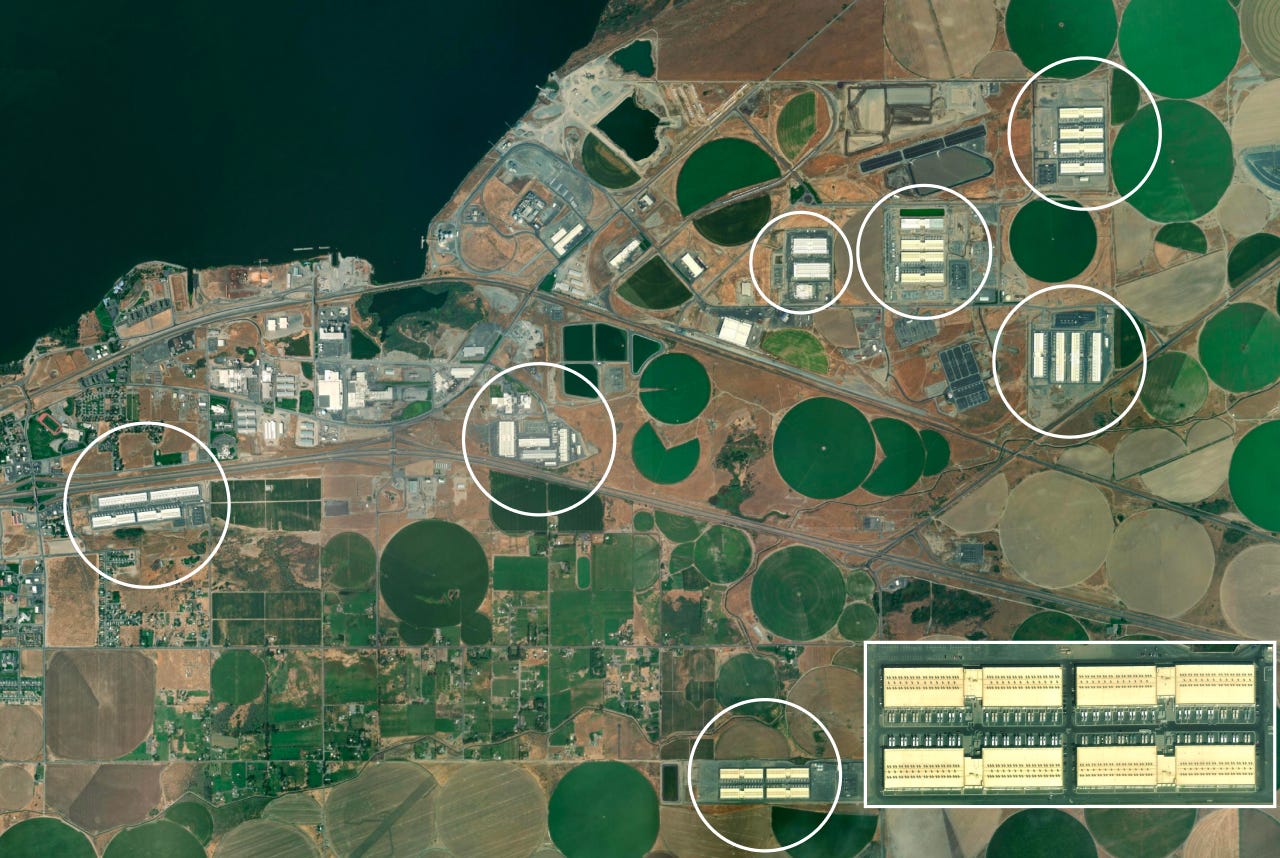
For years, that strategy worked. But beginning in 2020, Amazon began to run into issues securing power for its new data centers.
In 2023, the company built its PDX109 campus in Boardman, Oregon with the intention of using 266 MW of power. The company built its data centers, but the utility was only able to offer 40 MW.
Amazon’s first fix was to attempt to do what so many tech companies have done since: It filed a permit to build its own on-site generation, using Bloom fuel cells, which use natural gas to generate electricity. But the state’s environmental agency signaled that it wouldn’t approve the permit due to pollution concerns.
In 2025 the company ran into more power shortage issues. Another local utility, PacifiCorp, failed to deliver enough power for multiple campuses, according to a complaint filed with the utility commission.
Months later, Amazon bought the Sunstone solar and storage project.
Why Amazon is building solar and not gas
Elsewhere in the country, hyperscalers facing grid delays have built their own natural gas power plants. Meta recently partnered with the natural gas company Williams to build more than 1 GW of capacity in New Albany, Ohio. OpenAI and Oracle are building multiple gigawatts of gas capacity across Texas and New Mexico. And, as we reported this month, Amazon itself is building one of the country’s largest gas plants in West Texas.
In Oregon, public policy prevents such a strategy: HB 2021 effectively bars companies from building new fossil fuel power plants, whether they’re a utility or hyperscaler.
In other markets, Amazon might instead turn to clean energy developers and sign a power purchase agreement (PPA). But a failure to build transmission infrastructure has limited its options.
Since 2015, clean energy developers have requested 173 GW of new generation in BPA’s interconnection queue. Just 1 GW has been built. In the region, roughly 1 MW gets connected for every 168 requested.
Meanwhile, Amazon’s primary utility in the region was never built to serve this kind of demand. Umatilla Electric, a small rural co-op, saw its residential demand grow at about 0.37% per year before Amazon came to town. Amazon’s data centers now likely use 50 times more electricity than homes and farms in the area.
Why Amazon bought Sunstone
In this context, Sunstone offered the perfect opportunity for Amazon.
Sunstone entered BPA’s interconnection queue in 2021 and sits second in line at the Longhorn substation, which is located next to Amazon’s data centers. The project is fully permitted and “shovel-ready,” removing virtually all risk for the company.
Amazon will also be able to claim more than a billion dollars in federal tax credits. Sunstone will likely qualify for a 50% tax credit that was only available if the company began construction before July 4 of this year.
In outbidding Puget Sound Energy, the company also ensured that the project’s electricity will go to its data centers and not the competing utility’s customers hundreds of miles away.
“We are used to being kind of the only buyers for these things as utilities, and now there are other buyers who are a little bigger than we are,” Matt Steuerwalt, a Puget Sound Energy executive, recently said.
Even with its multi-billion dollar investment in Sunstone, Amazon will likely find itself short of the power it wants in Oregon. Cleanview estimates that the project will generate less than 10% of the electricity Amazon wants by 2032.
Project Sunstone and GW Ranch in Texas could be the beginning of a new chapter of Amazon’s life, not just as a tech company, but as an electric utility building some of the largest infrastructure projects in the country.
Sounds like consumers in Oregon won either way. And if Amazon can't utilize all of this green energy it can be rerouted onto the public utility market and if Amazon faulters a utility company could purchase the solar field. So to me its a win for Amazon and the public. That:s my read
PSE needs more renewable energy resources due to CETA — which states that all public utilities in WA need to be from clean energy by 2045. It makes sense PSE was bidding, but also loosing this power purchase agreement could mean A) complying to CETA regulations will become increasingly difficult if PSE is in competition with big-tech companies and B) customers will be on the receiving end of increased power bill costs.
Side note, this solar facility will span across 10,000 acres zoned as Exclusive Farm Use.