

Editor’s note: This story is based on extensive reporting and research that I did for Cleanview’s recently published behind-the-meter data center report. The 75-page report, which has been covered by The New York Times, The Wall Street Journal, and Bloomberg, is the most comprehensive analysis on the trend out there. You can read the free executive summary here.
From the moment that OpenAI announced its Stargate initiative, speed was central to its strategy. Standing next to CEO Sam Altman in the White House, President Trump said the initiative would be “the largest AI infrastructure project by far in history” and that the administration would act with “unprecedented speed and urgency” to support it.
Trump then hinted at how the company planned to build gigawatt-scale data centers faster than anyone else. “They'll build energy generation [at the AI data center] and that will be incredible.” Rather than wait for the utility, Stargate developers would effectively become their own utilities, building power plants “behind the utility meter.”
This strategy was as radical as it was novel. For decades data centers had been powered just like every other industrial operation in America. They called up the local utility, submitted a grid connection request, and soon after received electrons from the power grid. But the developers of Stargate believed this path to be too slow.
Between 2022 and 2024, when Stargate’s first project began construction, the number of data center power requests exploded—and the average time to connect a data center to the grid did too. In Northern Virginia, the timeline grew from two years to as much as seven years. In Ohio, the biggest utility stopped taking requests altogether after it was overwhelmed with demand.
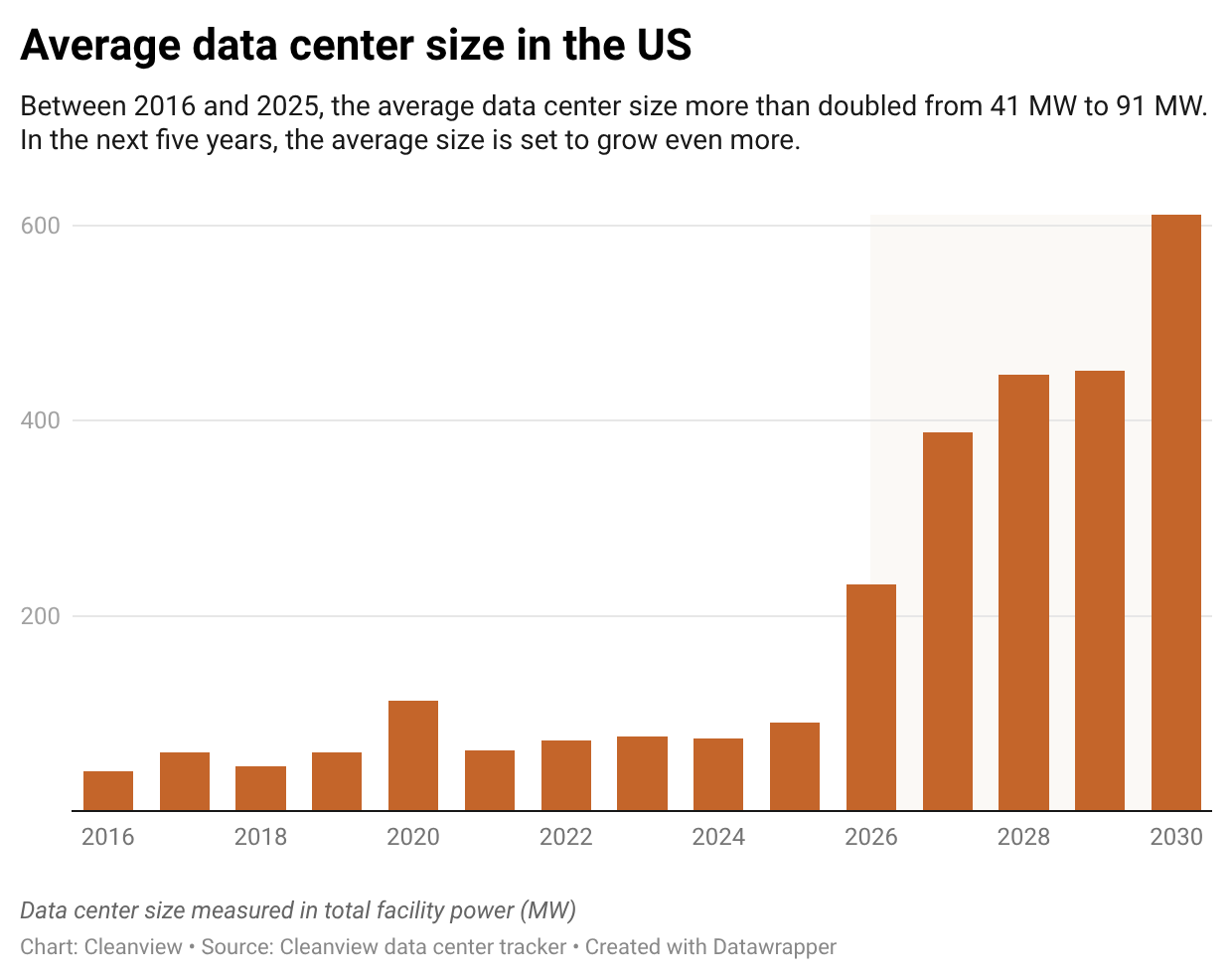
Speed to power wasn’t the only challenge facing OpenAI. The company also believed that it needed to build data centers at a scale unlike anything in history. In a 2020 paper, OpenAI researchers—including Dario Amodei, who would eventually defect to start Anthropic—popularized the concept of “scaling laws.” For all the smart techniques researchers were using to make AI models smarter, they found that the only thing that really mattered was how much compute and data you threw at the problem. The company didn’t want a 50 MW data center like the ones big tech companies had been building for the last decade; it wanted data centers with 20 to 40 times as much compute all connected in a single location by fiber optic cables. It wanted giga-scale data centers.
OpenAI decided that the only way to build that scale of data center quickly was to build its own power plants.
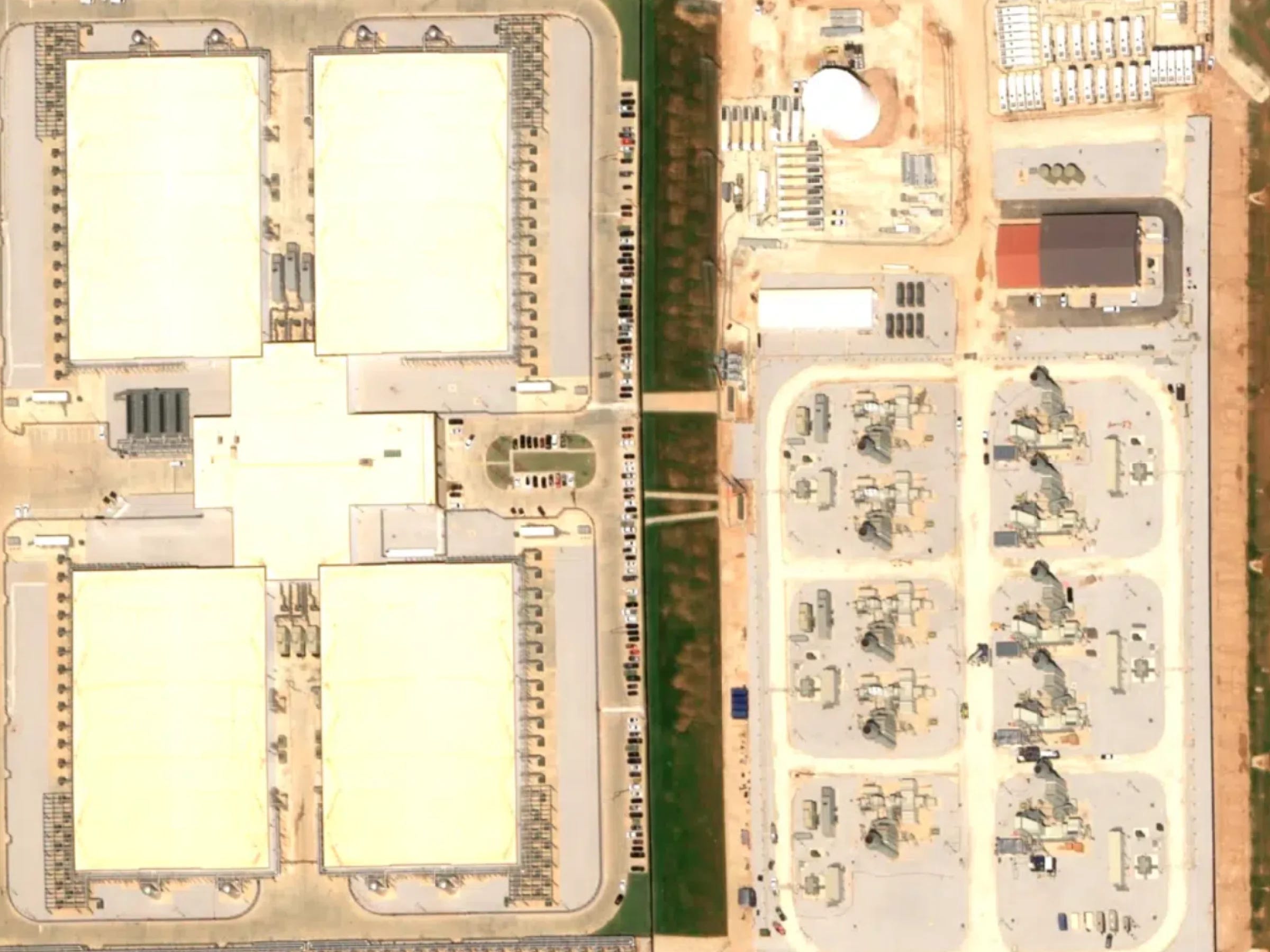
Five months before Stargate’s public announcement, OpenAI’s development partner, Crusoe, filed a permit in Texas to build a 360 MW power plant on the site of what would become the first Stargate data center in Abilene, Texas. Six days later, it was approved. In December 2024, the company ordered 10 GE Vernova turbines, and then in June 2025, it bought another 19 units that could collectively generate more than a gigawatt of power.
Crusoe didn’t buy GE Vernova’s combined-cycle turbines that form the backbone of the US power grid today though. Instead, they turned to the company’s jet engines—or aeroderivative turbines, if you prefer the more pedestrian nomenclature.
As demand for AI exploded, lead times for combined-cycle turbines grew to as long as seven years. Burned by the gas bubble of the early 2000s, the top three manufacturers of combined-cycle turbines said they didn’t plan to expand production much to meet this demand, instead choosing to boost prices and profits. So rather than wait seven years, Crusoe bought GE Vernova’s aeroderivative turbines that were originally made for passenger airplanes.
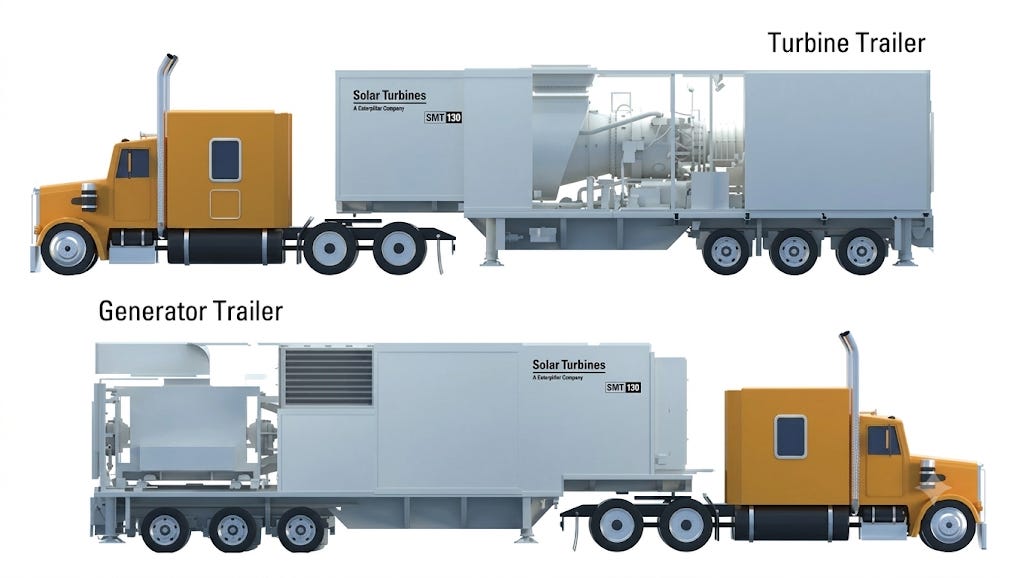
Elsewhere OpenAI’s development partners began cooking up plans to strap gas turbines to semi-trucks and even called up one of the world’s largest manufacturers of cruise ship engines to find power equipment.
By 2025, power equipment supply chains were becoming a game of whack-a-mole. As developers like Crusoe rushed to buy aeroderivative turbines, lead times grew quickly as they had in the combined-cycle market. To build the second Stargate data center, Vantage Data Centers—another OpenAI partner—ordered more than 670 reciprocating engines to generate 2.58 GW of power in Shackleford, Texas.
Further to the West, another OpenAI partner announced plans to power a data center on the border of New Mexico and Mexico with 2.45 GW of Bloom fuel cells. Prior to the AI boom, Bloom fuel cells generally powered commercial operations at single digit megawatt scales. Project Jupiter will be 2,400 times larger than the Honda office park that Bloom prominently features on its website.
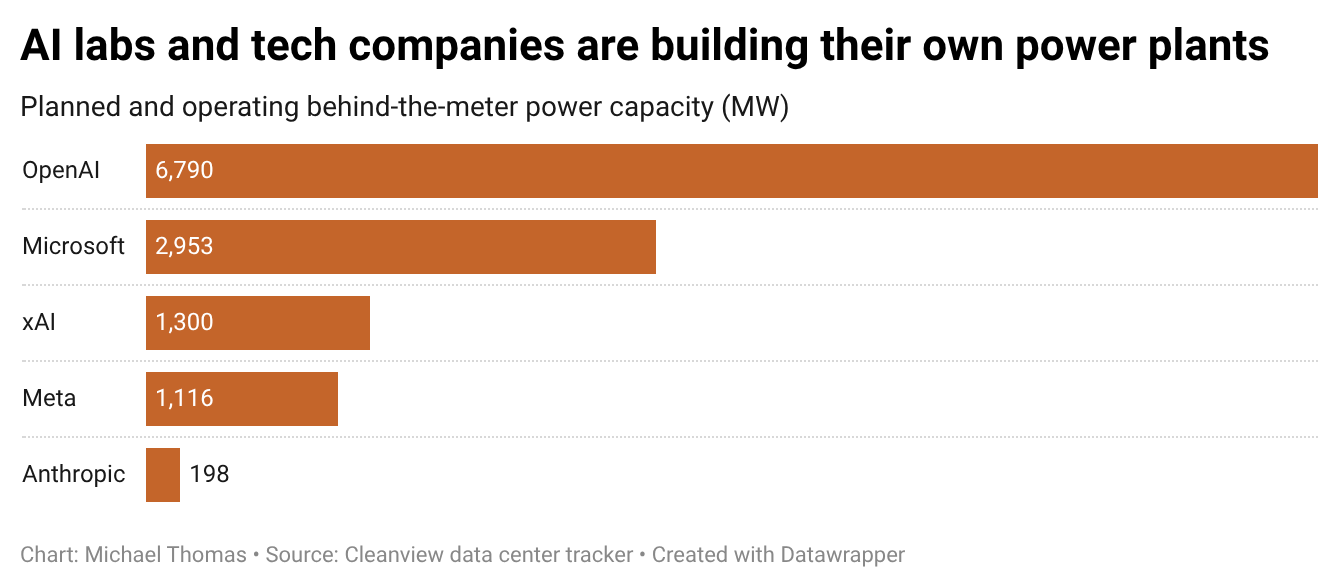
The scale of OpenAI’s buildout is hard to properly convey. No AI company has bet more aggressively on building its own power plants than OpenAI and its partners, according to Cleanview’s report on behind-the-meter data centers. Stargate developers are building 6.8 GW of their own power generation—more than the peak power demand of every city in America except New York.
At first, OpenAI’s strategy appeared to be working as expected. Crusoe began vertical construction on its first two data center buildings in Abilene, Texas in September 2024. Over the next year, thousands of people worked 24 hours a day to construct the data centers in record time. And they succeeded: 12 months later, the company announced that the buildings were operational—a faster timeline than any we’ve measured at Cleanview.
Soon after that, the first problems began to arise.
During its first winter in operation, Stargate Abilene went offline for days at a time due to issues with power and cooling equipment, according to The Information’s reporting. In March, OpenAI cancelled plans to expand its partnership with Crusoe in Abilene. (Crusoe later signed up Microsoft to take up the capacity).
Crusoe’s “fail and iterate” strategy “has definitely not been cheap,” according to an OpenAI engineer who spoke to The Information.
It’s also not clear that the strategy has achieved its goal of building a gigawatt data center as fast as possible. While Crusoe built the first two buildings of Stargate Abilene in record time, subsequent buildings have fallen behind schedule. The company began construction on the third and fourth buildings in March 2025. They originally planned to finish in March 2026, according to building permits. But in June 2026 the data centers still aren’t online, according to a recent press release from Crusoe.
These delays allowed Anthropic and its partners to build a gigawatt-scale data center before OpenAI. Around the same time that Crusoe began building Stargate Abilene, Amazon began building an 18-building data center in New Carlisle, Indiana for Anthropic. The company finished the first 500 MW of capacity in June 2025, touting its “world’s largest data center” to the New York Times and offering a tour. The data center surpassed 1 GW of power capacity in March 2026, according to Cleanview’s satellite analysis—five times more capacity than Stargate had at that time.
Ultimately grid power, not jet engines, delivered the first gigawatt data center.
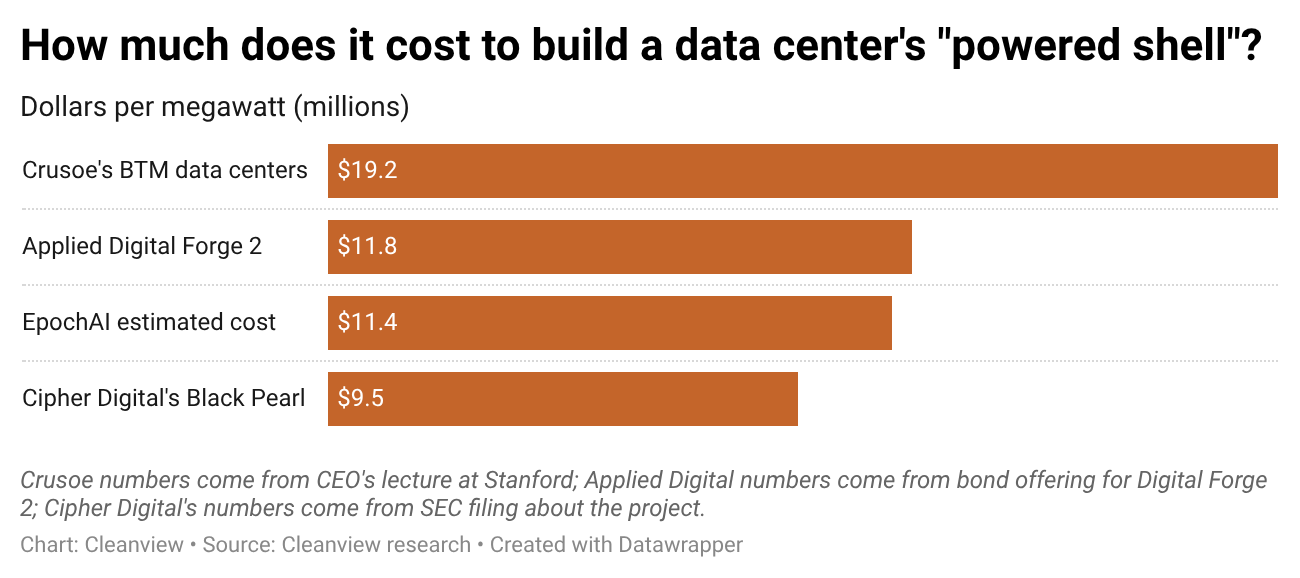
In addition to being slower than expected, building power plants has been expensive. A typical “powered shell”—an empty data center building without the expensive chips inside—costs $9-11 billion per gigawatt. Crusoe’s CEO Chase Lochmiller recently told a group of Stanford students that their data centers cost $19.2 billion per gigawatt once you factor in the gas plants—more than two times as much as one of Amazon’s data center partners is planning to spend to build a grid-connected project in Texas.
Crusoe isn’t the only OpenAI partner facing delays at their behind-the-meter data centers. In March 2026, New Mexico’s Land Office blocked a pipeline that would have delivered natural gas to Stargate’s Project Jupiter, the 2.45 GW data center on the border of Mexico. Environmental groups are now trying to convince FERC to slow down the permitting process in order to allow more time for public comment. If successful, the project could be delayed by years.
In New Jersey, neocloud developer Nebius is building a data center for Microsoft, which is OpenAI’s largest cloud provider today. To power the data center, Nebius and its development partner went to Norway to one of the largest cruise ship engine manufacturers in the world and secured 400 MW of engines, in a first of its kind partnership.
In order to build the power plant, Nebius’ development partner needs an air permit though. Efforts to obtain one have been blocked repeatedly. The project is supposed to come online later this year. But if it’s unable to get a “minor” pollution permit, the developer would be forced to request a “major” pollution permit, which would take years—if it were ever issued at all.
Delays at OpenAI’s data centers would be a significant setback, according to the company’s executives. Earlier this year, OpenAI’s COO, Denise Dresser, wrote a memo to employees amid rising competition from Anthropic. She argued that OpenAI had an advantage over Anthropic because it had so aggressively secured compute. “We saw the exponential compute curve earlier, acted on it faster, and now have a real structural advantage,” she wrote.
But Dresser’s argument assumes that OpenAI will finish its data centers on time and be able to use that compute.
In order for that to happen, the company and its partners will need to build gigawatt-scale power plants based on designs that have never been proven to work at scales larger than a few dozen megawatts. They will need to build gas pipelines, secure air permits, and then when all that’s done, they will need to manage huge fluctuations in power demand at their sites to protect tens of billions of dollars of advanced chips. In other words, they will need to build multiple electric utilities and power grids—a process that took America decades—in the span of two to three years.
OpenAI and its partners could do all this. Most technologists assumed that large-language models and transformers were a dead-end when OpenAI spent huge sums to train GPT 3.5. When their risky bet paid off, ChatGPT became the fastest-growing consumer product in history. Before Stargate, Crusoe had never built a large-scale data center; it built the first two buildings in record time.
But OpenAI’s bet on behind-the-meter power is a multi-billion dollar gamble that requires many things going right. Should the power plants fail to deliver, the company that saw the future first may find itself watching from behind.
Get the full behind-the-meter data center report
As I mentioned in the intro, today’s story is based on extensive reporting and research that I did for Cleanview’s recently published behind-the-meter data center report. The 75-page report, which has been covered by The New York Times, The Wall Street Journal, and Bloomberg, is the most comprehensive analysis on the trend out there. You can read the free executive summary here.
Fantastic work Michael Thomas - wow