

The future of America’s power grid is being written every day—in interconnection queues, regulatory filings, and documents that most people will never see.
A new solar project gets proposed in Texas and a spreadsheet is updated somewhere on the internet. A data center developer requests a local permit and a file is published on an obscure permit dashboard in Georgia. A battery storage facility breaks ground in Arizona as seen in a federal filing.
Until now, keeping track of all of this required checking dozens of sources, navigating difficult government websites, and tracking local news across hundreds of counties. The scale of changes that happen in a single day is more than any human can process on their own.
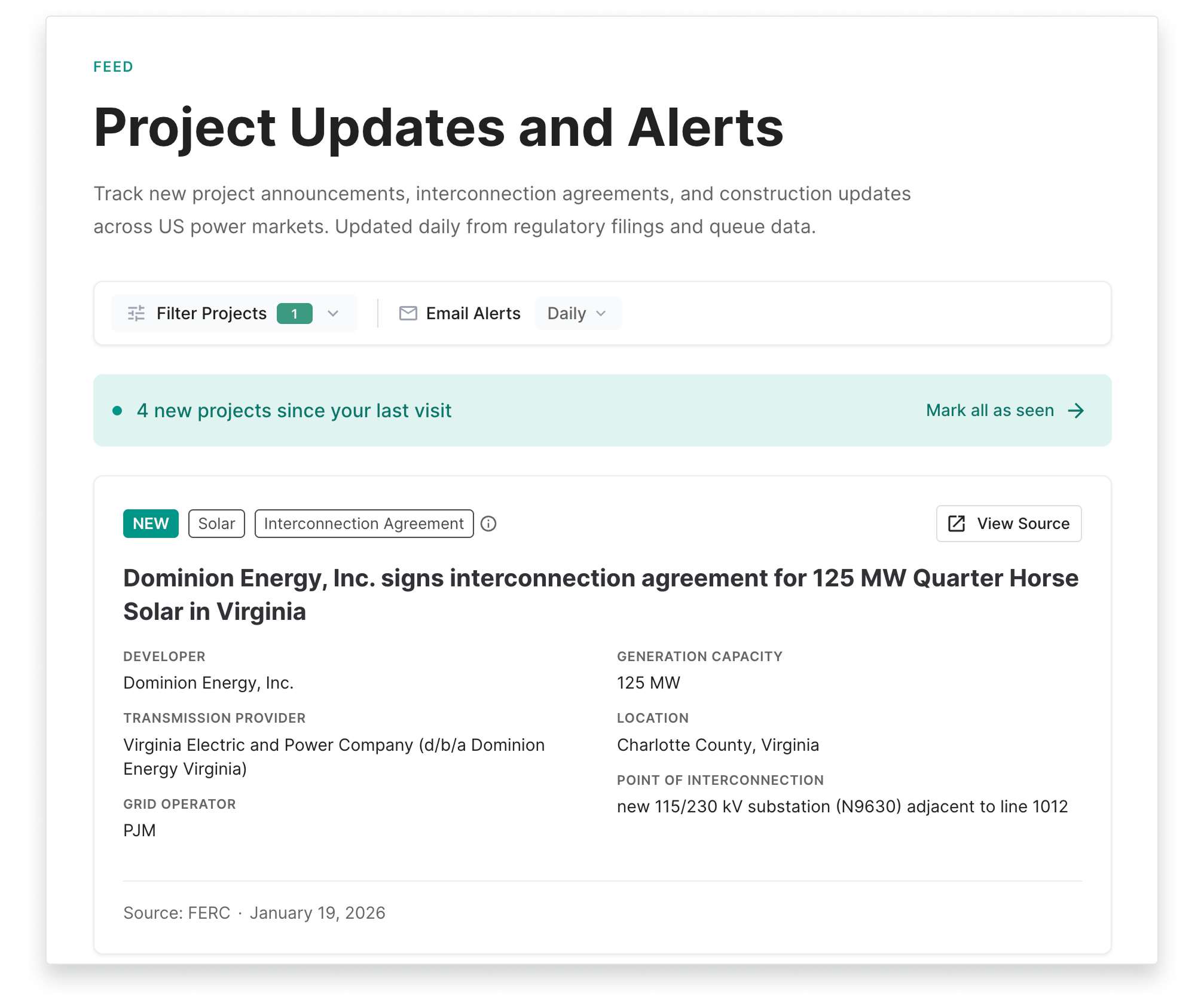
Today, I’m excited to announce the launch of Cleanview’s Project Feed and Email Alerts—a new way to track these changes across more than 10,000 power projects and 1,000 data centers in the US.
With the Project Feed, you can see a stream of updates as they happen. In our feed, you can find:
Newly proposed projects entering interconnection queues
Interconnection agreements being signed, which signal a project will almost certainly be built
Construction milestones
With Email Alerts, you can get these updates delivered to your inbox daily or weekly, filtered to the markets and project types you care about.
Examples of how you can use this
If you’re a project developer, understanding what’s happening in your target markets is critical. When a competitor signs an interconnection agreement in a county where you’re planning to build, that’s a signal. It means their project just went from speculative to almost guaranteed. Some of the largest developers in North America are already using Cleanview for this kind of competitive intelligence.
If you’re on a business development team selling equipment or services to developers, timing matters. The moment an interconnection agreement is signed is when a developer shifts from early planning to spending potentially billions of dollars. Being one of the first to know about that moment can make the difference between winning and losing a deal.
And if you’re an investor or analyst tracking the clean energy market, the feed gives you a real-time view of where capital is flowing. Instead of waiting for quarterly reports or secondhand news, you can see the actual filings and milestones as they happen.
If you’re an existing Cleanview customer, the Project Feed is available now in your dashboard. If you’re not yet a customer and want to see it in action, check out our 7-day free trial.
How we built this
Ok, now for the nerdy part for those of you interested in how we built this and what we learned in the process.
For the last few years, we’ve been tracking power projects and data centers across the US by pulling data from interconnection queues, federal filings, and public documents. But we realized that the raw data was only part of the picture. What our customers really needed was to know when something changed.
So we started watching for changes across all of these sources. We set up data pipelines to notify us whenever a project was added, changed, or removed. But we were quickly flooded with meaningless noise.
In the first three months of internal testing, we tracked more than 10,000 project changes. Most of them weren’t that helpful. A project might change from 100 MW to 105 MW, or an expected operating date might change from July 10th to July 20th.
In one case, ERCOT simply changed their code for battery projects from BAT to OTH and we were hit with thousands of updates. Then they changed it back. Oops!
After months of internal testing we got the update feed into a place where it showed true project signals and weeded out the noise.
Then over the holidays, I started to play around with Claude Code and Gemini’s API. For the uninitiated, Claude Code is a coding agent that has taken the world by storm. It speeds up the process of building software significantly. Gemini is one of many large language models. Importantly, its context window is massive meaning you can give it a 1,000 page PDF and ask it to extract key information and summarize the document.
Using these two tools, we scraped thousands of interconnection agreements filed in FERC’s E-Library. Because Texas does its own thing, we found a page with all the interconnection agreements filed in the state. Then we threw all of them at Gemini and asked it to extract details like the developer, project name, expected operating date, and so on.
Most of the issues we ran into were due to FERC’s poor documentation and file structure. Here, too, we used Gemini to categorize documents.
After a few weeks of development, we had a clean table with all these summarized documents. We combined that with our existing project changelog, mentioned above. And the feed was born.
The result is a tool that surfaces the information that actually matters, without requiring you to dig through government websites or parse through massive PDFs.
If you’re the kind of wonk that made it this far, you might be interested in Cleanview’s API. We haven’t added the project update feed as an endpoint yet, but we’ve been sharing a beta version with a few customers.
Our API plans start at $14,000 per year. If you’re interested in getting early access to the update feed endpoint, you can reach out here.