

Amazon and Meta have said they are building gas plants to power their data centers because it’s the fastest path to power. But this week, Google proved you can do it even faster with co-located renewables. And I found documents showing their strategy.
On Wednesday, Google announced a new data center in Texas that will be powered by renewables built by AES Clean Energy. The press release was light on details, so I used Cleanview’s platform to try to learn more about the project.
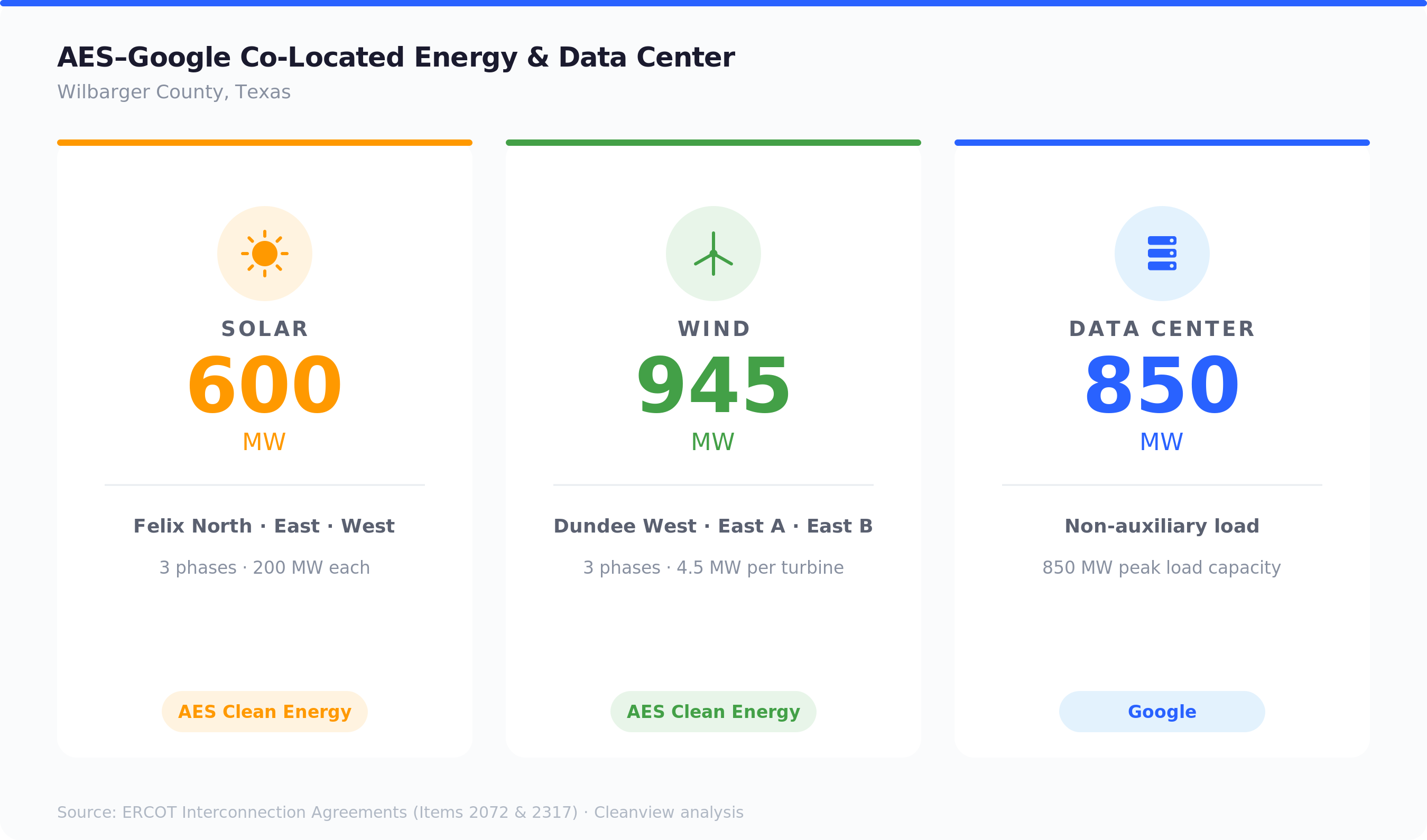
In December AES filed a document showing that it plans to connect an 850 MW data center (Google’s) to its massive solar and wind project in West Texas.
The project would use 600 MW of solar and 945 MW of wind power. Using both solar and wind enables near round-the-clock clean energy. And by connecting to the grid, Google gets the reliability it needs when solar and wind output drop.
But the creative part is how this deal enables Google to skip Texas’ large load queue and get online in 18 months instead of 5+ years.
Like the rest of the country, Texas has a massive backlog of data centers trying to connect to its power grid. At the end of 2025, the backlog was 225 GW—equivalent to 20 New York City’s of power demand.
For data center developers like Google that backlog means waiting years to connect to the grid. These delays have led some companies like Meta to start building their own gas power plants as I wrote in Cleanview’s latest report.
But Google found an alternative path—one that relies on a huge amount of onsite renewable energy.
Thanks to a recent rule change, a data center in Texas can piggyback off a power project’s interconnection agreement if its co-located. And that’s what Google appears to be doing here with AES. The documents we found suggest Google is using AES’ grid connection, which took years to secure to get around the ERCOT large load queue.
The wind phase of the project is expected to come online in August 2027. If Google had gone the traditional route, there’s no way they could have achieved that timeline. If they had tried to connect this data center in Virginia, they would have had to wait until the early 2030s.
It’s worth noting that this timeline is similar to the one Amazon and Meta are achieving by using natural gas. They’ve argued that they have to use gas because waiting for renewables delivered through the grid would take too long.
But with this project, Google is proving that it’s possible to build a 850 MW data center in 18 months powered almost entirely by co-located renewables.
Developers and policymakers should take note.
We wrote more about this project in a brief for Cleanview research subscribers. That brief includes a detailed project timeline, the equipment being used, and the broader policy and market context. Visit our website if you’re interested in becoming a subscriber.
What a gigantic waste of everyone’s time. Driving up pollution and now gobbling up renewable energy for…what? Scams and cheating on tests? I am praying for the day we can finally ban LLM’s and these data centers and retire the filthy gas plants.